Next-Gen Quality Management. Built for Compliance. Powered by AI.
Unpopular opinion: A completed safety checklist doesn’t mean a safer workplace.
A hazard is identified. An inspection report is submitted. A corrective action is marked complete.
On paper, everything looks good.
But was the hazard actually eliminated, or was the paperwork simply completed?
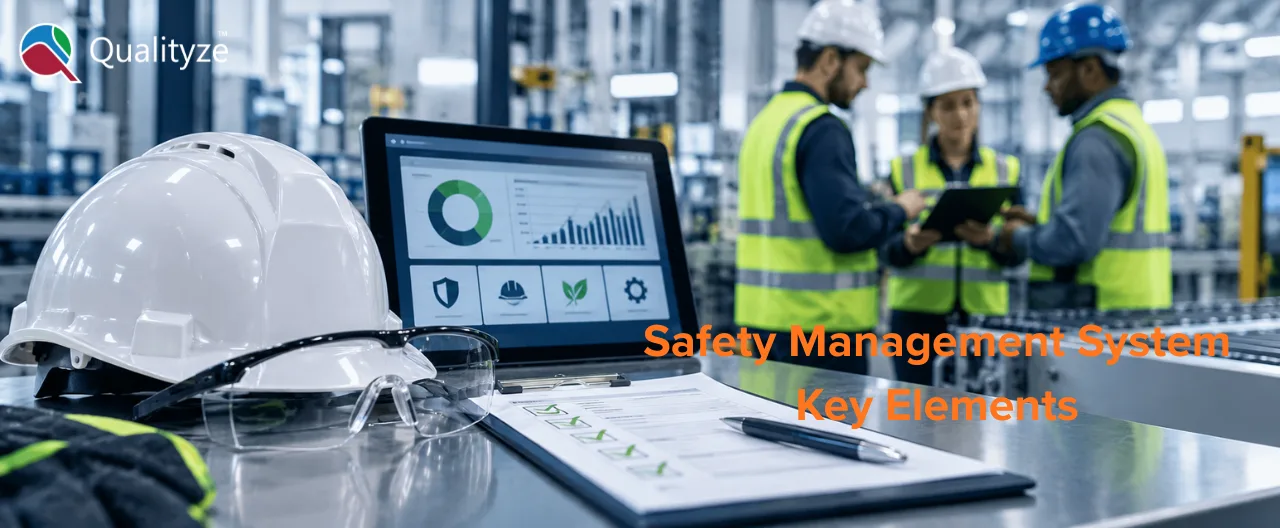
This is where an effective Safety Management System (SMS) makes a difference. It connects hazard identification, risk assessment, corrective actions, employee competency, and performance monitoring into a systematic approach to controlling risks and continuously improving workplace safety.
A Safety Management System (SMS) is a methodical approach to handling safety in addition to essential organizational structures, responsibilities, processes, and procedures to ensure the efficient identification, assessment, control, and monitoring of safety risks within a company. SMS helps companies offer products or services at the highest level of safety and sustain safe operations.
SMS also serves as a recognized way of fulfilling legal requirements. Major SMS processes include hazard identification, occurrence reporting, risk management, performance measurement, and quality assurance.
Currently, the international workplace safety market size is valued at $26.21 billion and is anticipated to cross $93.25 billion by 2034, registering a remarkable CAGR of 17.19%.
Key elements of a potent safety management system are as follows:
The way a company performs safety activities can be viewed through the prism of the behavior of the leaders and the commitment of management. If leaders pay sufficient attention to safety matters, provide all necessary resources and define what is expected in this respect, safety becomes a value and not just a matter of compliance.
As per OSHA guidance, “Management should clearly communicate their commitment to a safety and health program, define its goals, allocate resources respectively and then they can expect performance in return.”
The key components of safety leadership and management commitments are as follows:
On the other hand, weak leadership commitment can trigger:
The reason behind workplace injuries, illnesses, and events can be understood by defining the inability to identify or determine hazards. The identification and assessment of hazards is an essential part of an efficient safety program, which must entail a proactive, continual process of hazard identification and evaluation.
To measure and assess hazards, both the management and the workforce must:
To control exposure to hazards, every workplace must implement a hierarchy of controls. It typically includes five level of actions to reduce the impact of hazard or remove hazard completely, including:
Putting this hierarchy of controls to use will help improve worker’ safety while helping quality teams to identify the areas of potential improvement to prevent similar risks in the future,
An SMS guarantees the compliance of HSE (Health, Safety, and Environment) managers with regulatory requirements, decreasing the chances of getting fined and facing legal problems. ISO 45001, which is globally acknowledged as the quality standard for Occupational Health and Safety (OSH) management system, outlines the benchmarks against which most SMS applications are evaluated worldwide.
A proper Safety Management System makes it easier to produce compliance documentation automatically, create audit trails, and point out potential regulatory gaps before inspectors find them, which enables an organization to always comply with regulations rather than having to rush getting the paperwork done before an upcoming inspection.
Safety competency management comprises defining, reviewing, developing and maintaining the safety skills and knowledge required to carry out work safely. It is related to the health and safety management system and is one of the key requirements of the ISO 45001 standard.
Competency management is more than just organizing safety training courses. The process includes checking the effectiveness of training and whether workers use what they have learned on the job.
Companies that apply safety competency management report reduced number of incidents, better results of audits and a more confident working team.
Clause 7.2 covers competence exclusively and in detail. In this clause, the standard basically expects organizations to figure out which type of competence is required for people in OH&S (Occupational Health and Safety), make sure that individuals have the competence confirmed through education/training/experience, take steps in developing the needed competence and keep written proof of competence.
There's more to it than just completing the paperwork. The standard demands that organizations prove they manage competence instead of simply ensuring that there are training records on file. If during ISO 45001 audit it becomes clear that an individual who works safely doesn’t have documented competence, it results in a nonconformance.
In an industrial setting, accident reports can be associated with different situations. The scenarios may include a person falling on a wet floor or a failure of a pump seal that causes a harmful chemical spill. There are many situations that need to be registered, particularly if they cause lethal consequences for humans, resources, or ecology.
Lethal injuries are frequent, thus keeping workers safe should be a priority for an organization. OSHA reported 5,070 fatal injuries in the USA in 2024, which represents a decrease of 4% from 2023 at 5,283. Although positive change is evident, this proves the importance of safety rules and effective safety measures at workplaces.
The act of preparing an incident report refers to reporting an event such as an unforeseen incident, a near-miss occurrence, a failure of equipment or some emission incident. The incident report is written to carry out investigations for the occurrence, taking necessary action, and eliminating its future possibility. This is exactly what OSHA investigation guidance emphasizes.
Ensuring safety at work involves the use of multiple important safety metrics to identify potential hazards, assess the effectiveness of safety measures taken, and prevent accidents or injuries. The 15 key safety metrics are:
These metrics are categorized as leading and lagging indicators so organizations can evaluate and improve their safety performance.
Read More: OSHA’s Recommended Practices for Safety and Health Programs
In today's fast-emerging and cutting-edge operational environment, the protection and welfare of workers are one of the top concerns for organizations. Safety audits have gained prominence among organizations to improve workplace safety and ensure compliance with regulations.
These systematic studies are implemented not only to evaluate current safety practices and identify weaknesses but also to promote the culture of reliable operations. With its methodological approach to risk assessment, safety protocol analysis, and implementation of corrective measures, safety audits are helpful in the continuous process of making workplaces safer.
Safety audits are an integral part of corporate governance that entails an in-depth assessment of an organization’s safety management systems, policies, and practices. Such audits systematically identify hazards, assess existing measures, and make actionable recommendations for organizations to follow in the progress towards solving potential safety problems beforehand. By getting involved in the safety audit process, organizations mitigate risks, ensure the safety of managers and employees, and make them feel more responsible for the safety of their operations.
Therefore, the implementation of safety audits is an important process that helps organizations learn and gain feedback on their safety practices so they could continuously improve and ensure compliance with the requirements and standards of their respective industries.
The correlation between software results and safety results isn't direct, it's reliant on adoption and process excellence. When organizations implement safety management software effectively, the improvements are witnessed in the following ways:
The primary purpose for using safety management software is to promote safety, raise productivity levels, and improve efficiency while making sure compliance is properly observed. Implementing a digital system allows companies to control possible risks ahead of time, thus minimizing the possibility of accidents and injuries as well as ensuring compliance with all safety regulations.
Author

Qualityze Editorial is the unified voice of Qualityze, sharing expert insights on quality excellence, regulatory compliance, and enterprise digitalization. Backed by deep industry expertise, our content empowers life sciences and regulated organizations to navigate complex regulations, optimize quality systems, and achieve operational excellence.