Next-Gen Quality Management. Built for Compliance. Powered by AI.
In pharma quality, you cannot simply wait for a failed test to notice something wrong with the product batch. Sometimes, the earliest signal is a result that simply stops following the expected trend.
You are usually reviewing the stability data for a drug product. Noted the assay results. It is looking within the product specifications limit as per the checklist. You received no complaint, no feedback, or audit findings about the same. Everything looked within acceptable limits on paper.
But then you paused and observed that the latest result is lower than the previous time points. Though it has not crossed the thresholds, it is clearly at much difference from the expected trend. The product is still “in spec,” but it is no longer behaving as it should. That is where an Out of Trend, or OOT, result becomes important.
When we talk about the pharmaceutical quality control, OOT is a critical aspect one cannot ignore. It is often considered as an early warning signal that tells quality leaders that something in process, product, method, material, or stability profile is slowly shifting towards a full blown failure. OOT results may appear to be in specified limits unlike an Out of Specification (OOS) result.
It is generally about the failure of result that raises concerns in OOT. The real concern is about the changes that may need scientific review whether the drug is effective and safe for consumption. If you handle OOT investigations well through a systematic quality management process, you are likely to prevent risks that may become costly deviations, protect delivered quality of the product, and ensure GMP compliance. Most importantly, you can prevent the risk of warning letters coming your way.
In this blog, we will find out what OOT means in pharma, how it differs from OOS, what causes OOT results, how investigations should be handled, and how a connected QMS can help quality teams manage OOT events with confidence.
An Out of Trend, or OOT, result refers to the test result that remains within documented specifications but does not align with the expected or historical pattern of best results. To put it simple, the test result may show pass, but when you will compare it against the previous readings, it may look off even if it is the same product, batch series, method, stability interval, material, or process.
For example, you are reviewing assay results for a tablet product during stability testing. The approved assay specification is 90.0% to 110.0%. For the first few stability timepoints, the results look consistent:
|
Stability Timepoint |
Assay Result
|
|
Initial |
99.8% |
|
3 Months |
99.1% |
|
6 Months |
98.7% |
|
9 Months |
97.9% |
|
12 Months |
94.2% |
The 12-month result is still within the approved specification. Technically, the product has not failed. But when you compare it with the previous timepoints, the drop is unusual. The assay value has moved sharply away from the expected trend. That makes it a potential Out of Trend (OOT) result. The concern here is what the number is trying to tell you. Is it pointing to:
Product degrading. Is it happening faster than expected?
A sample handling issue?
An excursion in the stability chamber?
A variation in the method, analyst, equipment, or material used?
An OOT result gives you an opportunity to investigate the signal before it becomes a bigger issue, such as an OOS result, batch rejection, shelf-life concern, or regulatory observation.
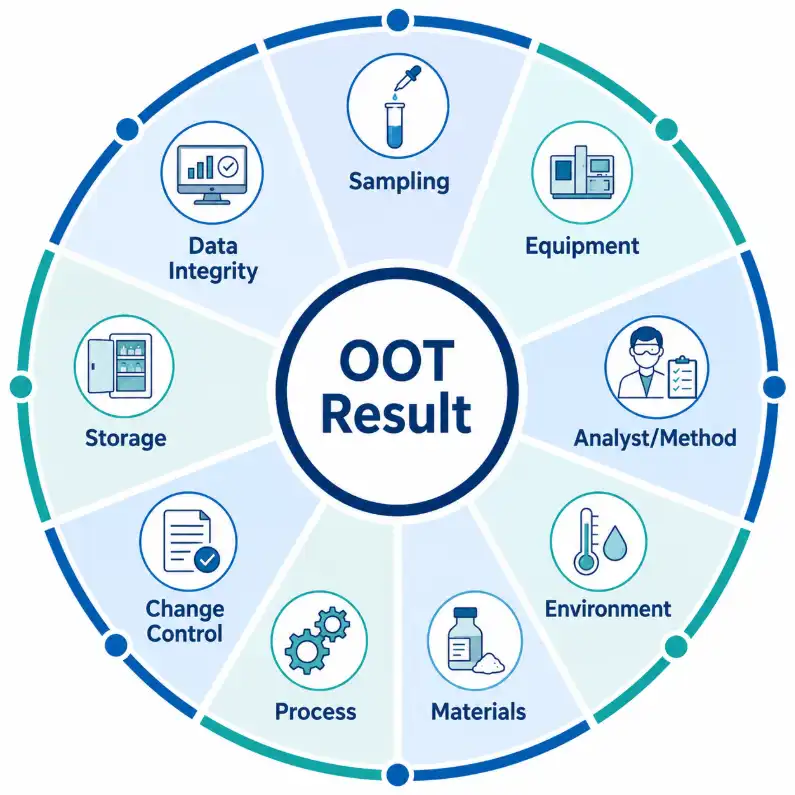
OOT results can come from different parts of the pharmaceutical lifecycle. Below are the most common types of OOT errors:
OOT results can happen for many reasons, including some due to laboratory execution and some due to manufacturing, materials, equipment, storage, or environmental conditions.
That is why, one should work based on assumptions during OOT investigations. A varying result, a drifting dissolution profile, or an unusual impurity trend may look like a product issue at first. But when you investigate the issue, you might find the root cause somewhere else entirely. The key objective is to understand the real reason of OOT that could range from a normal variation to a laboratory error, or a process signal to a broader quality risk.
Pharma is one of the highly regulated industries. They need to have OOT procedures in place so their teams can actually listen to the data. A well-defined OOT process helps spot unusual results within time, investigate the actual cause behind it, and decide the next best actions based on risks and impact. However, the AI Powered EQMS for Pharma makes it even simpler for you. AI analyzes the patterns and automatically recommends the next best actions for your unusual OOT results.
Not having a systematic process to manage OOT only leads to inconsistencies that could eventually pose compliance and patient safety risks. So you need to ask if the OOT results really aligned for best quality outcomes and safety? Or they are just another process layer that exists?
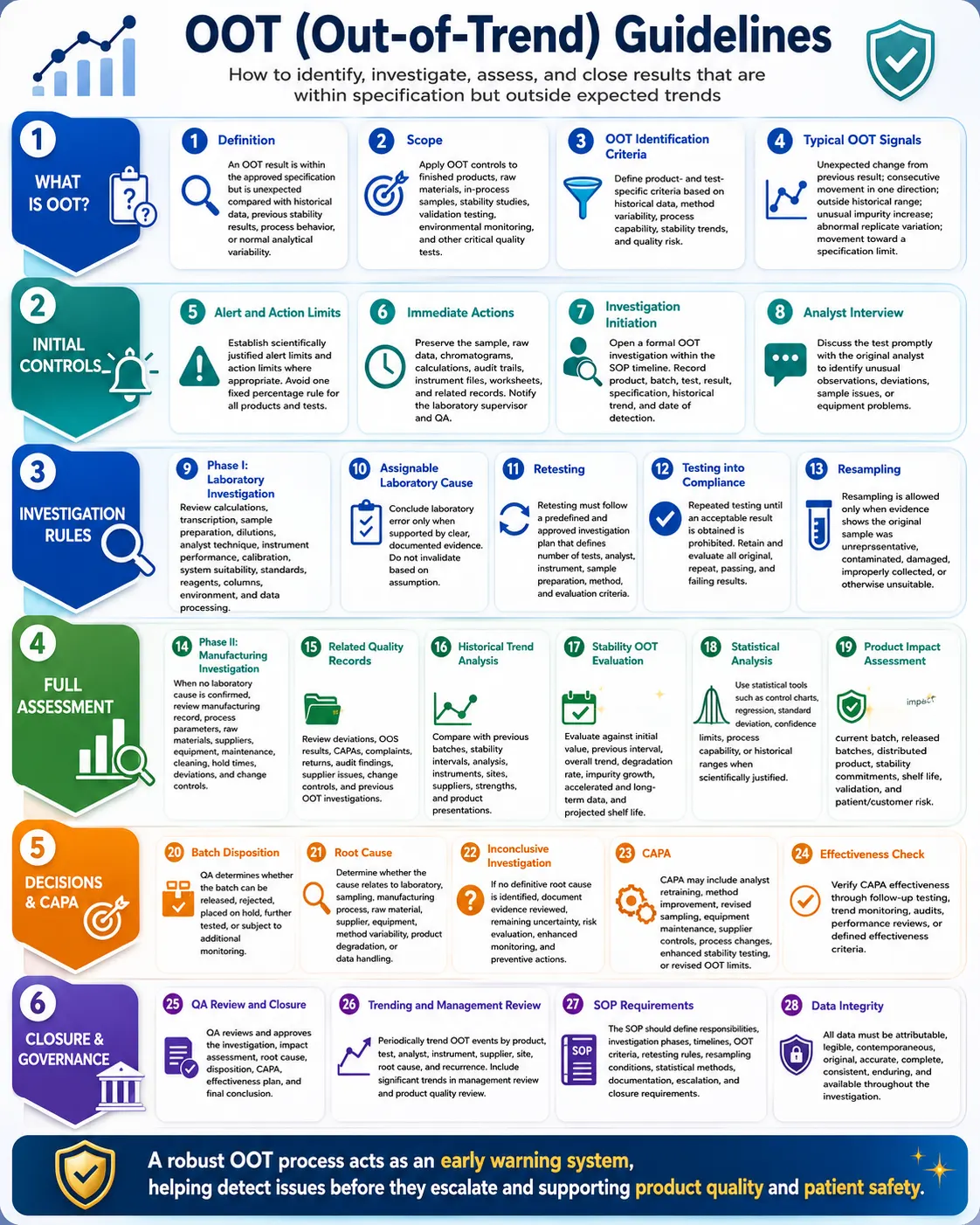
When an OOT result appears, the investigation should be structured, time-bound, and scientifically justified. The goal is to understand whether the result is valid, what may have caused it, and whether it has any impact on product quality. A practical OOT investigation usually moves through four phases.
In this phase, you attempt to understand whether the result variations are due to a laboratory issue or a documentation error.
An OOT result should be handled carefully, even when the result is still within specification. The goal is to understand whether the result is part of normal variation or an early sign of a quality issue. Here is a checklist you can use every time an Out of Trend result appears, even if the result is still within specification.
Under GMP expectations, pharma companies must maintain reliable laboratory data, review production and control records, investigate unexplained discrepancies, and make quality decisions based on scientific evidence.
In simple terms: OOS tells you a limit has been crossed. OOT may warn you that a problem is developing.
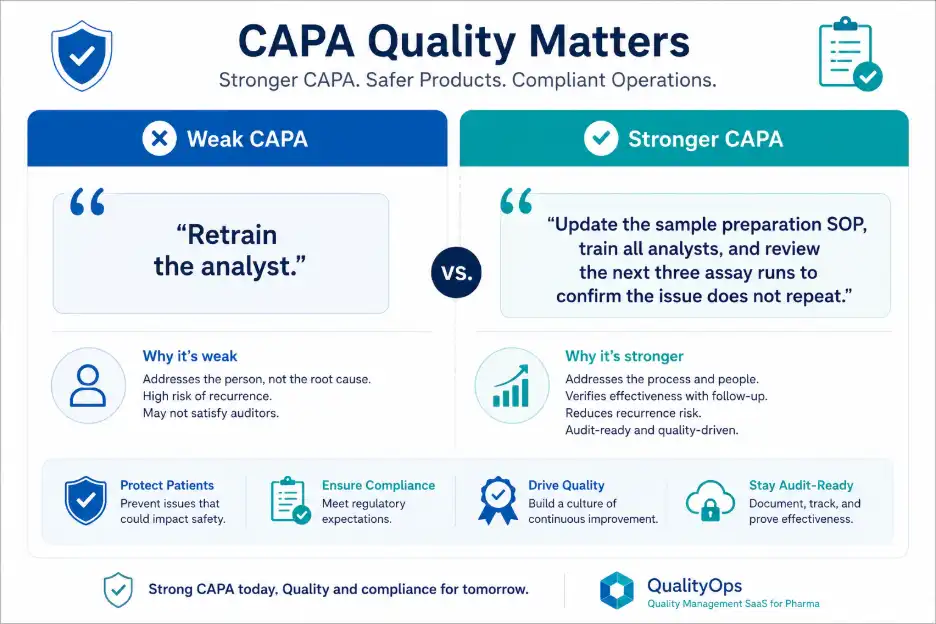
An OOT investigation identifies a real issue, and CAPA helps correct the problem and prevent it from happening again.
OOT monitoring is especially important in stability studies because a product can begin to shift before it fails specification.
Teams should monitor trends in assay, impurities, dissolution, moisture, pH, preservative content, microbial results, and appearance. When unusual trends are detected early, teams can make better decisions about shelf life, packaging, formulation, process control, and product quality.
OOT should be managed within the broader GMP and quality system framework. Even though guidance often focuses more directly on OOS results, unusual trends should not be ignored. You should maintain reliable data, scientific investigations, documented decisions, and strong quality oversight.
What counts as OOT
When an investigation is required
Who reviews and approves the investigation
What data must be checked
How product impact is assessed
When CAPA is needed
How closure is documented
In short, teams should be able to show that OOT results were detected, reviewed, investigated, justified, and closed properly.
Managing OOT investigations manually can be difficult when data is spread across spreadsheets, emails, lab records, stability reports, and CAPA files.
Qualityze helps pharma teams manage OOT investigations in a connected, closed-loop QMS. They can
Capture OOT events with complete product, batch, sample, test, and result details
Standardize the investigation workflows based on industry best practices
Assign owners, due dates, reviews and approvals
Link OOT records to CAPA, deviations, change control, audits, and training processes
Maintain a complete audit trail of events, investigations, approvals, and more
Track recurring trends across products, sites, batches, methods, and suppliers
Improve visibility for QA, QC, manufacturing, and leadership teams for better decisions
Author

Qualityze Editorial is the unified voice of Qualityze, sharing expert insights on quality excellence, regulatory compliance, and enterprise digitalization. Backed by deep industry expertise, our content empowers life sciences and regulated organizations to navigate complex regulations, optimize quality systems, and achieve operational excellence.