
Calculate your potential savings with our ROI Calculator
ROI Calculator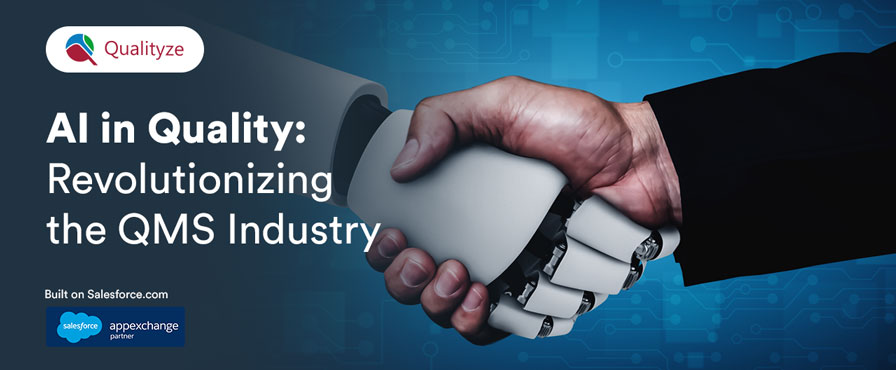
Maintaining the highest standards of quality in an ever-evolving landscape of industries like manufacturing, medical devices, pharmaceuticals, and food and beverages is not just a goal but a necessity. In today’s highly regulated and competitive landscape, organizations must consistently deliver safe, compliant, and reliable products.
Artificial Intelligence (AI) is emerging as a disruptive force reshaping the Quality Management System (QMS) industry. As a result, it is revolutionizing how businesses approach Quality Control (QC) and Quality Assurance (QA).
Quality management plays a critical role across industries by ensuring that products and services meet established standards and exceed customer expectations. At the same time, rapid technological advancements are changing how organizations manage quality. The integration of Artificial Intelligence (AI) is transforming traditional quality processes, making them faster, smarter, and more reliable.
In this blog, we explore the role of AI in quality management and highlight how it enhances efficiency, accuracy, and decision-making across the quality lifecycle.
One of the most significant contributions of AI in quality management software is the automation of quality control processes. By leveraging AI-powered data collection and analysis systems, organizations can streamline inspections, testing, and other critical quality activities.
AI algorithms can analyze vast volumes of data at high speed. Therefore, organizations gain real-time insights and faster decision-making, while reducing dependence on manual effort.
Furthermore, AI introduces predictive analytics into quality assurance. By using historical data and machine learning models, organizations can identify potential defects and process deviations early. This proactive approach enables preventive action, reducing the likelihood of quality failures before they occur.
Real-time monitoring and continuous improvement also become achievable through AI-driven insights. AI-based sensors and monitoring systems collect live operational data, track quality parameters, and flag anomalies instantly.
Moreover, adaptive AI algorithms detect patterns and trends that may escape human observation. As a result, organizations can address quality issues promptly, improve product consistency, and enhance customer satisfaction.
To unlock the full potential of AI in quality management, organizations must focus on data integrity. High-quality, unbiased, and reliable data is essential for accurate AI-driven insights.
Therefore, organizations should invest in robust data collection systems, address data gaps, and ensure consistent data availability across quality processes.
A leading automotive manufacturer implemented an AI-powered quality management system to enhance product quality. The system analyzed data from production lines, suppliers, and customer feedback channels.
As a result, AI algorithms identified potential defects and process deviations early. This allowed preventive measures to be implemented before issues escalated.
The system also enabled real-time monitoring and continuous improvement. Consequently, the manufacturer optimized its quality control processes, achieved a 30% reduction in quality-related costs, and recorded a 20% increase in customer satisfaction.
In manufacturing, precision and consistency are essential. AI plays a pivotal role in optimizing every stage of the manufacturing process.
By integrating AI-powered next-generation QMS solutions, manufacturers achieve higher efficiency and stronger quality control. AI algorithms analyze real-time data streams, identifying patterns and anomalies that human operators might overlook.
This early detection of defects reduces waste, improves yield, and enhances overall product quality.
Moreover, cloud-QMS platforms enable seamless collaboration and data accessibility across multiple manufacturing locations. As a result, quality standards remain consistent regardless of geography.
The medical devices industry demands zero tolerance for error. AI is transforming medical device manufacturing by supporting quality across design, production, and post-market surveillance.
AI-powered QMS ensures every stage adheres to stringent quality standards. Additionally, AI supports compliance with FDA regulations by improving documentation accuracy and audit readiness.
Therefore, medical device companies can reduce time-to-market without compromising safety or compliance.
AI is redefining quality management in the pharmaceutical and lifesciences sector. Drug development involves complex workflows and strict regulatory oversight.
AI-powered QMS automates repetitive tasks, allowing researchers to focus on innovation. At the same time, AI ensures continuous compliance with FDA regulations.
Consequently, approval timelines shorten, compliance risks decrease, and brand reputation remains protected.
In the food and beverage industry, consistent quality directly impacts consumer safety. AI-enabled QMS solutions provide real-time monitoring across sourcing, production, and distribution.
Cloud-QMS platforms enhance traceability. This allows organizations to track ingredients and finished products throughout the supply chain.
As a result, quality issues can be addressed quickly, minimizing recalls and protecting brand trust.
Additionally, AI supports predictive maintenance by identifying equipment risks early. This proactive approach improves operational efficiency and product consistency.
Cloud-QMS solutions form the backbone of AI-driven quality management. They provide centralized access to quality data, analytics, and collaboration tools.
This connectivity benefits organizations with global operations. Stakeholders can access real-time insights from anywhere, improving coordination and decision-making.
Moreover, cloud-QMS platforms enhance data security and integrity through encryption and backup mechanisms. This builds trust with regulators and customers alike.
AI is fundamentally transforming quality management by enhancing efficiency, accuracy, and decision-making. Its ability to automate processes and deliver predictive insights is reshaping industries.
Organizations embracing AI in quality management can significantly improve quality control, productivity, and customer satisfaction. By leveraging AI-driven insights, organizations can make informed decisions, optimize quality control processes, and stay ahead of the competition.
Incorporating Artificial Intelligence into the Quality Management System is a paradigm shift. Industries such as manufacturing, medical devices, pharmaceuticals, and food and beverages are witnessing a transformative journey toward unprecedented precision, efficiency, and compliance levels.
As companies embrace AI-powered next-gen QMS and cloud-QMS solutions, they position themselves at the forefront of innovation and competitiveness. The yoking together of artificial intelligence with quality management ensures regulatory compliance and paves the way for a future where excellence is not just a goal but a constant pursuit.
In this era of AI-driven quality management, the synergy between technology and industry expertise propels us into a future where the highest quality standards are not just met but exceeded, setting a new benchmark for excellence in the QMS industry.
Ready to elevate your quality management journey? Request a demo today and see how AI-powered QMS can transform your quality operations.
Author

Qualityze Editorial is the unified voice of Qualityze, sharing expert insights on quality excellence, regulatory compliance, and enterprise digitalization. Backed by deep industry expertise, our content empowers life sciences and regulated organizations to navigate complex regulations, optimize quality systems, and achieve operational excellence.