Next-Gen Quality Management. Built for Compliance. Powered by AI.

What is a Job Safety Analysis (JSA) and Why Is It Important?
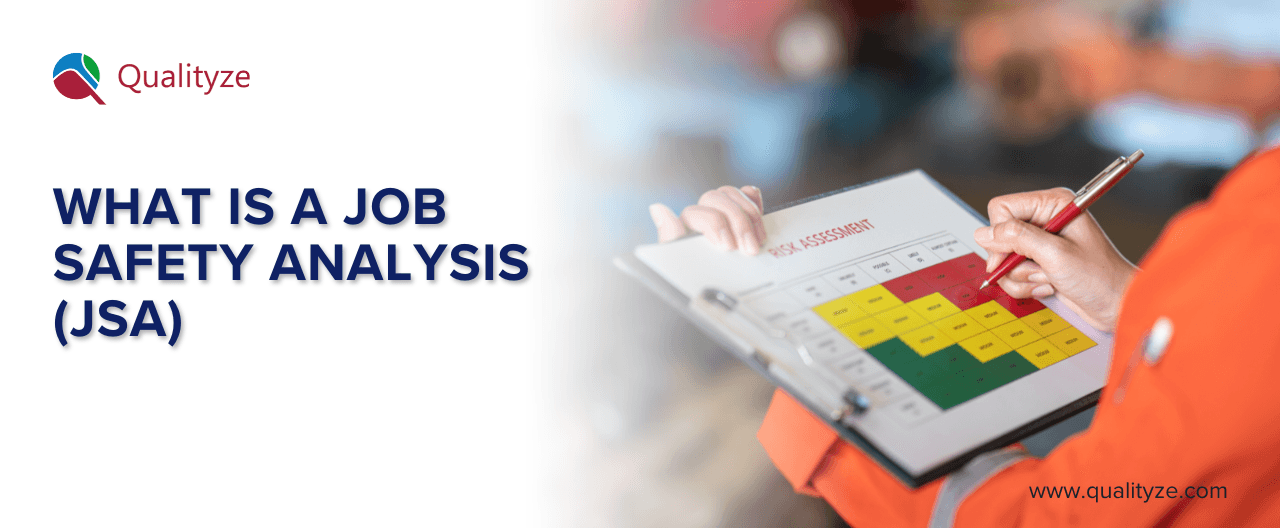
Organizations with a mature safety culture understand Job Safety Analysis (JSA) is not just a documentation activity, but rather a powerful operational tool to embed hazard awareness into every job function. JSAs break down tasks, identify latent risks, and assign preventive actions, therefore allowing companies to move from reactive corrections to proactive safety assurance.
Why Job Safety Analysis Matters Today?
For industries operating in high-risk or highly regulated environments, such as manufacturing, aerospace, construction, or pharma, a robust safety analysis process is no longer optional. Indeed, it is mission-critical. Moreover, by formalizing JSA practices, companies reduce incident rates, improve workforce readiness, and drive accountability. They also ensure alignment with evolving standards like ISO 45001 and OSHA 1910.
"Proactive hazard identification tools such as JSAs are linked to significant reductions in workplace injuries when applied consistently." — OSHA"
In this blog, we decode what a Job Safety Analysis involves, its strategic purpose, key benefits, how to conduct it step-by-step, the difference between a JSA and JHA, and how intelligent systems like Qualityze EQMS can automate and enhance the entire process.
Let’s start with the foundational question—what exactly is a Job Safety Analysis, and why does it matter so much in today’s safety-conscious work environments?
What is a Job Safety Analysis (JSA) and Why Is It Important?
A safe work environment is not only a legal requirement, but it also acts as a foundational pillar of operational excellence. Among the most effective instruments organizations utilize to bolster safety is a Job Safety Analysis (JSA). A JSA methodically assesses probable dangers in every action of a job task, therefore enabling organizations to apply controls prior to accidents occurring. It decomposes every task into sequential steps, identifies related risks, and suggests safety practices or personal protective equipment (PPE).
By closing the gap between procedural control and real-world risk mitigation, a JSA is more than merely a safety checklist—it is a roadmap to a culture of accountability, prevention, and ongoing improvement. In particular, compared to overall risk assessments, JSAs target specific tasks or operations—especially those with elevated injury or incident rates. Moreover, the process enhances both hazard identification and team communication, as workers who conduct the task on a daily basis are usually involved. Consequently, this participative aspect promotes collective understanding of risks and instills responsibility at all levels.
Which industries depend on JSA?
Firms operating in high-risk sectors like construction, oil and gas, manufacturing, and healthcare heavily depend on JSAs for compliance with regulatory requirements and workforce protection. In addition, JSAs have recently picked up momentum in corporate, logistics, and warehousing industries within larger environmental, health, and safety (EHS) programs.
Did you know? More than 2.3 million workers die from work-related accidents and diseases globally each year, and there are approximately 340 million non-fatal occupational injuries annually. These figures highlight why robust safety analysis systems are essential. Source
Furthermore, in the United States alone, roughly 2.5 million nonfatal workplace injuries and illnesses were reported in 2024, representing the lowest incidence rate in over two decades, and yet the need for a proactive safety culture remains critical.
What is the Purpose of a Safety Analysis?
The main purpose of a safety analysis, especially a JSA, is to avoid workplace accidents, enhance operational effectiveness, and meet occupational health requirements. Rather than reacting to incidents after they occur, organizations apply JSAs to sense potential failures and avoid them beforehand.
Safety analyses fulfill several functional purposes:
- Hazard Recognition: Identifying hidden or unnoticed risks in normal tasks
- Risk Elimination: Planning control measures ahead of an incident
- Training and Awareness: Instilling safety standards within teams
- Regulatory Compliance: Adhering to industry standards like OSHA, ISO 45001, or local EHS requirements
Through recording these observations, JSAs serve as excellent references for onboarding, internal audits, and safety inspections, thereby strengthening long-term culture and institutional memory. Additionally, in changing work environments, JSAs assist in reassessing risks as operations expand or modify.
Advantages of Job Safety Analysis Implementation
JSA program implementation yields practical benefits that extend beyond safety signs and PPE procedures. Some of the most significant advantages include:
1. Reduction of Injuries: By cataloging task-related hazards, organizations can greatly minimize the risk of physical harm and reduce expensive downtime.
According to OSHA data, industries that strengthen safety training see injury reductions of 30%–50%, demonstrating how structured hazard analysis and training bring measurable impact.
2. Enhanced Task Clarity: By having steps and risks clearly documented, employees know not just what to do—but how to perform it safely.
3. Increased Communication: Joint JSAs encourage open communication among supervisors, safety representatives, and frontline employees, therefore fostering a culture of responsibility and awareness.
4. Assurance of Compliance: A written JSA procedure facilitates internal and external audits and complies with OSHA, ANSI, and ISO 45001 safety compliance regulations.
5. Continual Improvement: Because JSAs are periodically reviewed, they help progressive safety programs and make adjustments for changing equipment, material, or process improvements.
6. Risk Awareness Training: A JSA can serve as an in-the-moment training tool, providing new employees insight into particular hazards and proper countermeasures.
The Business Impact of Job Safety Analysis on Organizational Performance
In addition to operational benefits, Job Safety Analysis (JSA) delivers measurable business value across multiple performance indicators.
For instance, companies that adopt JSAs as part of their safety management strategy often realize reductions in direct and indirect costs. These cost savings occur because fewer incidents result in lower workers’ compensation claims and less operational downtime.
Furthermore, a strong JSA program supports higher productivity. When workers clearly understand task hazards and control measures, they spend less time responding to unexpected issues. Consequently, supervisors can allocate time and resources to strategic initiatives rather than reactionary problem-solving.
Moreover, insurers and compliance bodies increasingly reward organizations with robust safety performance. According to a 2024 Liberty Mutual Workplace Safety Index report, employers can save up to $60 billion annually by preventing serious workplace injuries through proactive safety programs. (Source: Liberty Mutual Workplace Safety Index)
Therefore, investing in JSAs does not just protect employees—it improves financial performance and strengthens operational resilience. In fact, companies with mature JSA systems often outperform their peers on safety and productivity benchmarks, making safety analysis a business priority rather than a compliance checkbox.
Basic Steps to Perform a Job Safety Analysis
A properly implemented JSA uses a systematic, repeatable process. Following are the five steps necessary to provide complete coverage:
1. Choose the Job to Analyze
Prioritize tasks that are high-risk or high-frequency. Look at jobs with:
- History of incidents
- Danger of severe consequences
- Use of complex equipment
2. Analyze the Job into Sequential Steps
Disassemble the job into separate steps, usually 5–10 per task. Emphasize what is done—not how it is done.
3. Recognize Hazards in Each Step
Assess every step for possible hazards, including:
- Mechanical hazards
- Environmental exposure
- Human error
- Equipment failure
4. Establish Preventive Measures
For every recognized hazard, describe mitigation measures such as:
- Administrative controls
- PPE requirements
- Engineering solutions
- Training protocols
5. Document and Review the JSA
Document findings in a standard template and distribute to all concerned stakeholders. Moreover, establish regular review and updates, particularly when any job parameters change.
A digitally enabled system such as Qualityze EQMS assures these steps are captured, monitored, and updated in real-time.
Note: OSHA suggests dividing a job into 5–10 steps for efficient JSAs—any fewer can risk missing hazards.
Common Challenges in Implementing JSAs and How to Overcome Them
Although JSAs offer significant safety and business benefits, many organizations still face implementation challenges. One common obstacle is worker resistance, especially when employees view JSAs as extra paperwork rather than a tool that protects them. To overcome this, involve frontline workers early in the process and emphasize that their insights directly improve safety outcomes.
Another challenge is time constraints. Teams under operational pressure may rush through JSAs or schedule them infrequently. However, by embedding JSAs into routine planning meetings and allocating dedicated time for safety analysis, organizations can ensure consistent execution without disrupting operations.
In addition, inconsistent documentation can undermine the effectiveness of JSAs. Different teams may use varied templates or standards, leading to gaps and confusion. Therefore, establishing a standardized JSA form and training employees in its use helps maintain quality and clarity.
Moreover, a lack of ownership can stall the JSA process. When roles and responsibilities are unclear, JSAs may remain incomplete or outdated. To address this, assign JSA champions within every department who can coordinate reviews, updates, and training.
Lastly, outdated JSAs often fail to reflect current job conditions, especially when processes evolve quickly. A practical solution is to schedule regular JSA reassessments tied to change management events, such as new equipment introductions or revised procedures.
By systematically addressing these challenges, organizations can strengthen their JSA programs and unlock greater safety and performance gains.
Job Safety Analysis vs. Job Hazard Analysis
Though used interchangeably in many contexts, Job Safety Analysis (JSA) and Job Hazard Analysis (JHA) have nuances to them:
| Feature | Job Safety Analysis (JSA) | Job Hazard Analysis (JHA) |
| Focus | Safety of job steps | Hazards associated with tasks |
| Scope | Task-specific | Broader operational risks |
| Usage | More common in U.S. | More common internationally |
| Outcome | Safer job execution | Holistic hazard management |
A JHA is part of an overall safety program, whereas a JSA provides a task-specific breakdown. Therefore, both promote a safer, better-informed workplace when done properly.
Role of Training and Employee Participation in Successful JSAs
A successful Job Safety Analysis depends heavily on effective training and active employee participation. Without these two elements, even well-designed JSAs can fail to produce meaningful safety outcomes.
First, training ensures that all team members understand the purpose of a JSA and how to complete it correctly. Training sessions should cover how to identify hazards, assess risks, and document controls. Additionally, providing practical examples during training helps employees apply JSA principles to real-world tasks.
Moreover, involving employees in the JSA process gives them a voice in shaping safety practices. Workers who perform specific tasks daily often know hazard nuances that are not obvious in procedure manuals. Therefore, engaging these frontline workers can lead to more accurate hazard recognition and more effective control measures.
In many organizations, safety briefings or “toolbox talks” that incorporate JSA discussions have boosted risk awareness and ownership. Consequently, when workers feel that their insights are valued, they are more likely to follow safety procedures and share improvement ideas.
Furthermore, ongoing coaching and refresher training help maintain JSA quality over time. Since job conditions and equipment can change rapidly, making JSA training part of regular safety meetings ensures that knowledge remains current.
In summary, integrating training and employee participation into JSA programs builds a culture of collective responsibility and strengthens long-term safety performance.
Qualityze EQMS to Automate the Job Safety Analysis Process
Manual performing and maintaining JSAs can be labor-intensive, error-filled, and uneven. That's where Qualityze EQMS (Enterprise Quality Management System) comes in to deliver revolutionary value.
Using Qualityze, organizations are able to:
- Digitize JSA template standards
- Automate version management and task monitoring
- Assign review and approval processes
- Merge training and corrective measures
- Record audit-ready compliance records
The system guarantees that each JSA is:
- Centralized document-based
- Timely reviewed
- Shared with appropriate team members
- Monitored for performance metrics
As a result, not only is safety enhanced, but data integrity is improved, compliance is accelerated, and a proactive safety culture is promoted.
Concluding thoughts on the blog
Rolling out a clearly defined job safety analysis is a forward-thinking step toward creating a safer, more compliant, and more efficient workplace. Furthermore, from task analysis to risk reduction and employee training, a JSA informs every facet of safety operations.
In today’s dynamic environment, streamlining your JSA process with an effective solution like Qualityze EQMS guarantees accuracy, accountability, and ongoing improvement—without burdening your team's administrative tasks.
How Digitalization is Reshaping Safety Management?
As workplace environments evolve, so too must safety analysis practices. One of the most significant trends shaping modern safety programs is digital transformation. Digital tools such as mobile applications, cloud-based platforms, and connected devices are enabling organizations to capture, analyze, and act on safety data more rapidly than ever before.
In the coming years, artificial intelligence (AI) and machine learning may further enhance safety analysis by automating risk scoring and suggesting control measures based on historical performance. As a result, organizations that adopt digital-first safety strategies will likely see improved compliance, lower incident rates, and stronger operational resilience.
Ultimately, the future of workplace safety belongs to organizations that combine robust safety frameworks like JSA with digital innovation and data-driven insights.
Key Takeaways
- A JSA is a task-specific tool for identifying and preventing workplace hazards
- It improves training, compliance, communication, and operational efficiency
- Regularly reviewing JSAs drives ongoing safety improvements
- Automating JSAs with Qualityze EQMS ensures accuracy and consistency
Ready to Create a Safer, Smarter Workplace?
Ready to streamline and standardize your safety analysis processes?
Explore how Qualityze EQMS can help you standardize your JSA processes and build a future-ready safety culture.
Author

Qualityze
Qualityze Editorial is the unified voice of Qualityze, sharing expert insights on quality excellence, regulatory compliance, and enterprise digitalization. Backed by deep industry expertise, our content empowers life sciences and regulated organizations to navigate complex regulations, optimize quality systems, and achieve operational excellence.
The Start of Something Amazing.