Next-Gen Quality Management. Built for Compliance. Powered by AI.
In the high-stakes world of modern manufacturing, life sciences, and global supply chains, ‘quality is not just a fixed goal or a checkbox on a regulatory form. Today, quality is a living, breathing metric, a competitive expanse that separates market leaders from those fated to fade away in obsolescence.
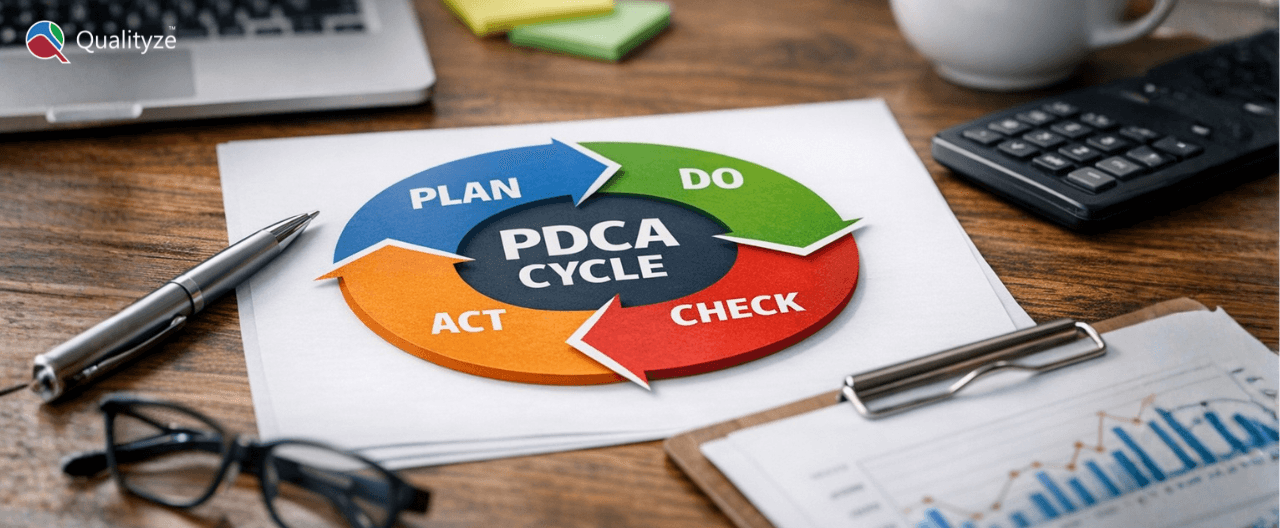
At the soul of every successful QMS from legacy frameworks to AI-driven platforms, lies a modest yet insightful four-stage methodology, Plan-Do-Check-Act (PDCA). Implementation of PDCA in manufacturing demonstrated a major decrease in product defect rates, reducing from 50% to 27%.
PDCA is more than just a workflow, it is the central "operating system" of continuous improvement. We will explore how the PDCA approach drives modern quality, its role within the QMS ecosystem, and why it is the most vital tool for any quality expert in the digital age.
The PDCA Cycle, often referred to as the Deming-Shewhart Cycle, is not merely a checklist, it is the fundamental operating system for structural agility and operational excellence. While Walter A. Shewhart theorized the iterative nature of quality, it was Edwards Deming who transformed it into a stringent, organized philosophy for evidence-based problem-solving. In modern enterprise, PDCA serves as the bridge between tactical intent and sustainable execution.
To master the cycle, one must go beyond the surface-level definitions and embrace its systematic depth:
True planning surpasses goal setting. It involves a granular root-cause analysis to define a baseline. In this phase, you are not just deciding ‘what to do,’ you are formulating a testable hypothesis.
Execution is best accomplished as a small-scale pilot rather than a global rollout. This stage is about data collection and technical reliability. The aim is to implement the change under specific conditions to reduce risk while capitalizing on the learning yield.
This is the most critical phase that requires a cold, objective comparison of the ‘Do’ results against the "Plan" benchmarks. You are looking for the delta, the gap between expectation and reality, to decide if the change was a true enhancement or a statistical irregularity.
If the pilot succeeds, the ‘Act’ stage involves normalizing the new process across the firm to thwart backsliding. If it fails, it serves as a pivot point. In either setup, the cycle does not end, it resumes, powered by the intelligence gained from the earlier loop.
While the PDCA cycle is deceivingly simple in theory, its effectiveness is totally dependent on the thoroughness of its execution. To transition from a reactive ‘firefighting’ mode to a state of operational excellence, firms must treat PDCA not as a checklist, but as a strategic engine for value creation. Here’s how high-performing companies refine the cycle into a competitive advantage:
PDCA is often misinterpreted as a tool for ‘one-off’ problem-solving. In truth, its power is derived from compounding gains. If applied only to isolated emergencies, you are merely patching holes. To see complete results, PDCA must be applied to core processes that involve incremental optimization. It is the difference between a single repair and an ongoing evolution.
The goal of a quality-driven firm is to move past the performance of a methodology and into the character for it. Take Toyota’s Kata as the gold standard. The continuous improvement outlook is deeply ingrained that the acronym ‘PDCA’ is hardly spoken, the logic is part of the company’s DNA. Success is achieved when Plan-Do-Check-Act ceases to be a meeting agenda and starts being the default cognitive framework of every employee.
A common misconception is that PDCA adds layers of bureaucracy. In contrast, the framework is designed for scalability. The most frequent failure point is not the ‘Plan’ or the ‘Do,’ but the failure to close the loop in the ‘Check’ and ‘Act’ stages. Without an orderly review of the data and a formal standardization of the fix, the cycle remains a bleeding wound of wasted effort.
PDCA is only as intelligent as the metrics fueling it. Companies must move beyond ‘vanity metrics’ and align their KPIs with precise strategic outcomes. If the aim is waste reduction, the focus shouldn't just be on output, but on granular variables such as first-pass yield, cycle time variability, and scrap-to-revenue ratios. You cannot improve what you do not precisely quantify.
Large firms often struggle with the perceived friction between speed and the thoroughness of a review. However, skipping the Check stage to save time is a false economy. It almost guarantees the repetition of errors, leading to a ‘technical debt’ of quality issues. By launching a consistent cadence whether through daily stand-ups or quarterly strategic reviews, leaders can preserve agility without forgoing the analytical integrity that prevents future failures.
To learn how PDCA drives a QMS, we must first deconstruct its four pillars. While the concepts appear straightforward, their execution requires a level of discipline that many firms struggle to maintain.
The ‘Plan’ stage is where quality is defined. In a QMS context, this involves recognizing a problem or an opportunity for improvement and forming the goals and processes needed to deliver results.
Defining the Gap: Is the non-conformance rate too high in the assembly line? Is the document approval cycle taking too long?
Risk-Based Thinking: Modern QMS standards such as ISO 9001:2015, mandate that ‘Planning’ must include risk assessment. What could go wrong? What are the ripple effects?
Setting KPIs: You cannot improve what you cannot measure. Planning involves setting quantifiable targets.
‘Do’ is the implementation stage. However, a customary fallacy is that this means a full-scale rollout. In a true PDCA cycle, the ‘Do’ phase is usually a pilot or a small-scale trial.
The ‘Check’ stage is where the most noteworthy failures in quality management happen. Many companies ‘Plan’ and ‘Do’ but they are unsuccessful in meticulously evaluating the results.
Data Analysis: Comparing the pilot results against the KPIs set in the ‘Plan’ phase.
Audit & Monitoring: This is where the Internal Audit and Non-Conformance modules of a QMS shine. They offer the ‘mirror’ that reflects the reality of the process.
Identifying Deviations: Did the change produce the expected outcome? If not, why? Was it a failure of the plan or a failure of execution?
The ‘Act’ stage closes the loop. Based on the ‘Check’ findings, the firm takes action to improve the process.
A modern QMS is not a single tool, it is a collection of unified modules. The PDCA cycle acts as the glue that holds these modules together. Let’s look at how specific QMS modules map to the PDCA cycle.
In the PDCA cycle, the documents you possess are your ‘Truth’. When you Plan, you draft an SOP. When you Act, you review that SOP based on your learnings. A QMS offers the version control and ‘Single Source of Truth’ that stops people from working off outdated information, the silent killer of quality.
You cannot ‘Do’ properly if your workforce isn't proficient. The Training Management module ensures that as soon as a process is ‘Acted’ upon, the relevant workers are automatically enrolled in retraining. This leads to a seamless shift from ‘Standardization’ to ‘Execution.’
Non-conformances are the ‘Check’ stage in action. They are the red flags that state, ‘The plan is not working.’ The CAPA module is the ‘Act’ stage, delivering a structured setting to probe root causes and implementing a permanent fix.
Whether you are dealing with FDA 21 CFR Part 11, ISO 13485, or IATF 16949, the fundamental prerequisite is always the same, Demonstrable Continuous Improvement. Regulators don't want to see only a good product, they want to have a system that finds out and fixes bad ones. PDCA offers the audit trail.
This methodical approach transforms ‘luck’ into ‘compliance.’
Today, the PDCA cycle is getting a massive upgrade via AI and ML.
Traditionally, ‘Planning’ is based on historical data. Today, AI modules within systems such as Qualityze can perform Predictive Quality Analysis. The ‘Plan’ stage now includes predictions, allowing for pre-emptive planning.
The ‘Check’ stage used to take several weeks of data aggregation. In the modern QMS ecosystem, IoT sensors on the manufacturing floor feed data directly into the ‘Check’ unit. The QMS performs real-time statistical process control, flagging nonconformities the instant they happen.
Today, we are witnessing the rise of ‘Closed-Loop Quality.’ In some innovative environments, if the ‘Check’ stage senses a minor deviation, the QMS can adjust machine parameters or pause a batch, efficiently acting in milliseconds to stop waste.
Despite its benefits, many firms suffer from PDCA Fatigue, the propensity to skip the ‘Check’ and ‘Act’ stages because they are time-consuming. This leads to a ‘Plan-Do, Plan-Do’ cycle where errors are more frequent, and ‘continuous improvement’ becomes a muted catchphrase. To surmount this, leadership must leverage the Dashboarding and Reporting features of their Quality Management Software. By imagining the ‘Cycle Time’ of a CAPA or the ‘Closed-Loop Rate’ of non-conformances, quality managers can keep the impetus alive.
The PDCA approach is not a software feature, it is a cultural commitment. A QMS provider like Qualityze offers the architecture for PDCA, but the drive must come from a collective understanding that quality is never finished. By embedding PDCA into every module, from Calibration to Change Management, firms move away from firefighting and toward a state of Operational Excellence. In 2026 and beyond, the firms that thrive will be those that treat the PDCA cycle not as a routine, but as their most potent growth engine.
In an era of swift industrial evolution, Qualityze stands as a decisive, cloud-native pillar for companies pursuing operational excellence. More than just a CAPA management software, Qualityze serves as a digital architect for the PDCA cycle, institutionalizing the Continuous Improvement mindset through high-velocity automation and data integrity. Qualityze transitions the conventional PDCA cycle from a static conceptual model into a dynamic, automated engine for growth:
By automating the friction-heavy manual stages of the PDCA cycle, Qualityze removes the ‘compliance lag’ that often throttles innovation. The platform offers a united ‘single source of truth,’ majorly minimizing human errors and fast-tracking speed-to-market. Additionally, for firms navigating stringent regulatory landscapes, the Qualityze Audit Management module ensures that every process is eternally audit-ready and aligned with global ISO standards.
Author

Qualityze Editorial is the unified voice of Qualityze, sharing expert insights on quality excellence, regulatory compliance, and enterprise digitalization. Backed by deep industry expertise, our content empowers life sciences and regulated organizations to navigate complex regulations, optimize quality systems, and achieve operational excellence.