Next-Gen Quality Management. Built for Compliance. Powered by AI.

How to Prevent Offsite Risks in the Construction Industry
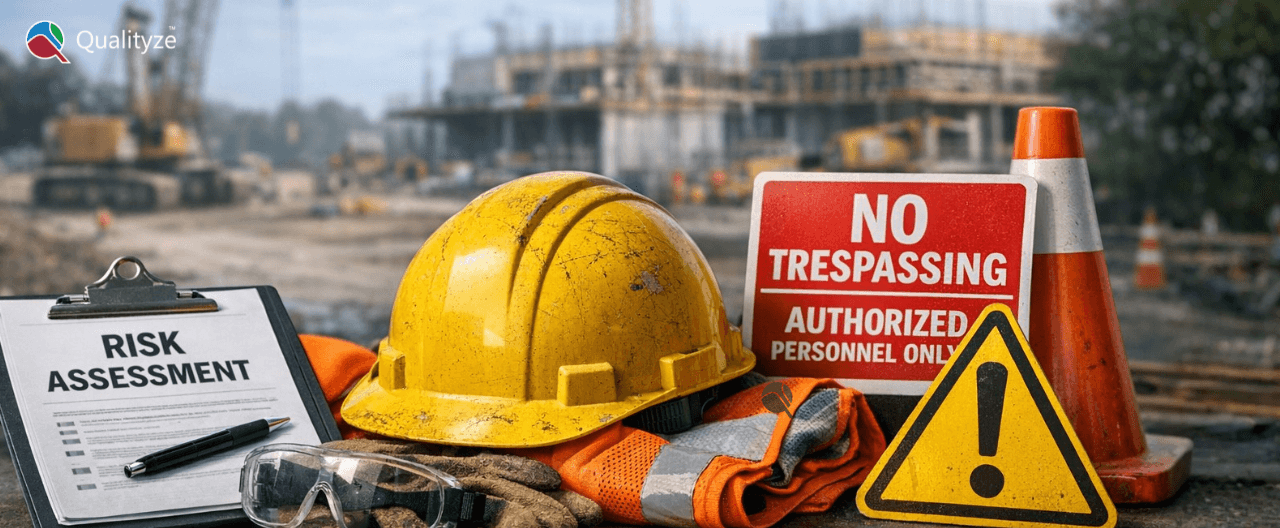
Preventing risks in the construction industry is often viewed through the lens of on-site activities wearing hard hats, safeguarding scaffolding, and piloting heavy machinery. However, the modern construction landscape, administered by complex Quality Management Systems (QMS), identifies a second, equally critical category- Offsite Risks.
These process-related hazards often take place behind the scenes in design offices, procurement departments, and boardroom meetings, yet their impact on the construction site can be calamitous. When these process risks are left unsupervised, they manifest as physical hazards, structural failures, and legal liabilities. A McKinsey study found that late detection of defects can increase costs by 30% due to rework, scrap, and lost opportunities.
Pillars of Proactive Transformation
In the high-stakes environment of modern construction, banking on manual safety protocols is no longer just a logistical challenge, it is a major operational risk. Achieving the necessary levels of visibility to manage contractor integration, risk mitigation, and zone-access control requires a digital-first transparency that paper-based systems cannot offer.
The following pillars define the transition from reactive management to a proactive culture of excellence:
-
Navigating Regulatory Complexity
The construction industry is governed by a thick web of regulations, ranging from scaffolding integrity and noise mitigation to high-altitude safety standards.
-
- Documentation Burden: Each regulatory requirement demands stringent documentation to validate compliance.
- Resource Intensity: Managing these obligations manually often demands a dedicated resource just to track paperwork rather than active safety monitoring.
- Safety Sensitization: Beyond checkboxes, ensuring every worker is sincerely informed to specific site hazards is a non-negotiable task that entails structured, traceable training workflows.
Navigating regulatory complexity in the construction industry is increasingly reliant on QMS, with 85% of survey respondents in a 2025 PwC study stating that compliance requirements have become more complex in the last three years.
-
Real-Time Multi-Site Visibility
For firms managing projects across geographically dispersed sites, "lagging indicators" are inadequate.
-
- Data-Driven Oversight: Safety professionals need real-time data streams to recognize emerging issues before they intensify into incidents.
- Seamless Communication: Effective risk mitigation depends on prompt communication of new controls and updates to every stakeholder, from site managers to third-party contractors.
Real-time multi-site visibility, enabled by digital QMS and integrated with technologies like IoT, BIM, and drones, has become a critical driver of efficiency in the construction industry.
-
Engineering a Culture of Engagement
True safety is not a top-down mandate, it is a shared behavioral standard.
-
- Proactive Participation: The objective is to evolve beyond the safety professional’s oversight and create an atmosphere where every employee is a proactive participant in safe behavior.
- Transparency as a Tool: By leveraging transparent systems, firms can build a culture where safety is inherent to the workflow, rather than an external obstacle to be cleared.
Implementing a digital QMS can reduce rework costs by an average of 45% and speed up non-conformance report (NCR) closure times by 72%. This extensive blog explores ways to thwart offsite risks within a QMS framework, incorporating best practices for safety, hazard prevention, and health management.
Understanding Offsite Risks in a QMS Context
In high-stakes construction environments, risk is not a monolithic threat but a two-tiered hierarchy that dictates project safety and viability:
- Onsite Hazards: These are the "front-line" kinetic threats encountered during execution. Falls from height, high-voltage electrocution, and heavy machinery malfunctions. While these are the most visible points of failure, they are ultimately the final links in a much longer chain of causality.
- Offsite Risks: These are the "invisible" failures that occur long before a worker steps onto the site. They manifest as fragmented communication, inadequate resource allocation, flawed technical specifications, or poor logistical planning. Offsite risks are the silent architects of onsite accidents and create hazardous conditions that make human errors inevitable.
The QMS as a Strategy for Risk Pre-emption
A sophisticated QMS, aligned with standards like ISO 9001, reclassifies safety from a peripheral compliance checkbox to a core quality output. By embedding risk-based thinking into the organizational DNA, a QMS allows firms to identify and neutralize systemic vulnerabilities during the pre-construction phase.
Instead of reacting to an incident after it occurs, an integrated QMS leverages CAPA and rigorous document control to ensure that every planning decision from supplier selection to site-specific safety plans is verified and validated. This holistic approach ensures that potential risks are mitigated while they are still on paper, long before the first shovel hits the ground.
Key Offsite Risks and Their Prevention Mechanisms
Offsite risks are stealthy as they are often unseen until an incident occurs. Within a QMS, these are managed through stringent documentation, change control, and stakeholder management.
-
Incomplete or Inaccurate Design Drawings
Many construction accidents stem from a ‘design-execution gap.’ If architectural or structural drawings are unfinished or fail to account for Mechanical, Electrical, and Plumbing coordination, workers on-site will be forced to improvise.
Prevention Mechanism: Put into action a Design Review and Verification process. Include project managers and site engineers during the design phase to ensure buildability. Use Building Information Modeling to accomplish "clash detection" and recognize technical risks early.
-
Poor Change Management
Construction projects are dynamic. A ‘minor’ change in material or a structural modification made in the office can have enormous safety implications on-site.
Prevention Mechanism: A consolidated Change Management System within the QMS. Every change must activate a mandatory risk reassessment. This ensures that when a design changes, the safety protocols are updated at the same time.
-
Labor Shortages and Subcontractor Turnover
The construction industry banks significantly on third-party contractors. High turnover is an indication of safety culture being diluted.
Prevention Mechanism: Contractor Prequalification and Competence Mapping. Within the QMS, keep a registry of approved contractors based on their safety performance metrics. Ensure that each new person hired, irrespective of their contract length, undertakes a standardized digital induction.
-
Ethical and Financial Risks (Profits over Safety)
Under pressure from inflation or tight deadlines, firms often cut corners.
Prevention Mechanism: Leadership Accountability and Transparency. QMS standards require top management to exhibit a commitment to quality and safety. Transparent bidding processes and internal audits prevent the ‘bribery risk’ where safety is put aside for cost-cutting.
Best Practices for Safety Management in the Construction Industry
Safety management today is no longer about paper logs, it is about real-time data and cultural alignment.
-
The PDCA Cycle for Safety
Integrating safety into the Plan-Do-Check-Act (PDCA) cycle ensures continuous improvement:
-
- Plan: Launch safety goals and identify critical inspection points (e.g., foundation depth, steel spacing).
- Do: Implement standardized digital checklists and mobile-based inspections for site supervisors.
- Check: Use analytics dashboards to track defect rates, near-misses, and contractor compliance scores.
- Act: Use Corrective and Preventive Actions (CAPA) to address recurring safety gaps.
-
Digital Quality and Safety Inspections
Replacing paper-based Construction Inspection Reports with digital tools ensures that data is accessible in real-time. Digital QMS platforms such as Qualityze enable on the spot photo uploads and time-stamped logs, creating an undisputable quality audit trail.
-
Worker Participation and Psychological Safety
A top-tier safety program emboldens workers to state hazards without fear of retaliation. Best practices include ‘Toolbox Talks’ where the crew discusses explicit daily risks and ‘Stop Work Authority’ where any worker can stop a task they believe is unsafe.
Types of Safety Hazards and Prevention Mechanisms
While offsite risks create the circumstances for failure, understanding physical threats is vital for the ‘Check’ stage of the QMS. Modern safety management extends beyond preventing ‘accidents’ to shielding long-term worker health.
- Noise Management: Conduct noise assessments. Offer high-quality hearing protection and use silent machinery where possible.
- Vibration Control: Extended use of power tools leads to Hand-Arm Vibration Syndrome (HAVS). Implement work rotations and use low-vibration tools to protect workers' nerves and blood vessels.
- Chemical Safety: Maintain a digital Safety Data Sheet (SDS) library. Ensure all workers handling hazardous paints, adhesives, or solvents are trained in emergency spill response.
Integrating ISO 45001 with ISO 9001
The most efficient firms do not manage quality and health/safety in silos. By integrating these standards, you can achieve:
- Reduced Duplication: One audit, one training program, and one reporting system for both quality and safety.
- Streamlined Documentation: A single "Management Review" process addresses both customer satisfaction and worker well-being.
- Proactive Risk Identification: Risk-based thinking becomes the default for every department, from procurement to site execution.
We are entering an era of "Connected Safety." Advanced QMS platforms now leverage:
- IoT and Wearables: Sensors on hard hats or vests that alert workers when they enter a high-risk zone.
- AI Predictive Analysis: Algorithms that scrutinize historical incident data to foresee which sites are at the highest risk of an accident in the coming week.
- Drones for Inspection: Using drones to inspect high-altitude structures or unstable terrains without putting human lives at risk.
Eliminating offsite and onsite hazards in the modern construction landscape demands a fundamental paradigm shift, moving beyond the physical perimeter to the digital and procedural core. It is no longer sufficient to merely secure the site. True resilience lies in securing the process. A sophisticated, AI-integrated QMS provides the rigorous framework necessary to intercept design flaws in the pre-construction phase before they manifest as structural failures. By institutionalizing a seamless Change Management workflow, a QMS ensures that every mid-project adjustment is vetted for safety and compliance rather than being rushed through as a quick fix.
Furthermore, the system acts as a Single Source of Truth, verifying that every contractor and employee on the ledger is not only authorized but culturally empowered to prioritize zero-harm safety over production velocity. When the boundaries between quality and safety dissolve into a single, unified objective, the result is a project that is more than just an asset, it is a testament to engineering that is built to last because it was built to protect.
Managing offsite risks shouldn’t slow down your construction projects. Discover how a unified QMS helps you monitor vendors, track compliance, and mitigate risks in real time—schedule your free demo today.
Author

Qualityze
Qualityze Editorial is the unified voice of Qualityze, sharing expert insights on quality excellence, regulatory compliance, and enterprise digitalization. Backed by deep industry expertise, our content empowers life sciences and regulated organizations to navigate complex regulations, optimize quality systems, and achieve operational excellence.
The Start of Something Amazing.