Next-Gen Quality Management. Built for Compliance. Powered by AI.
Ever wondered why product development feels like a huge task? The manufacturing and product development phases in current times highly depend on coordination that traditional mediums can no longer fulfill. In fact, as complexity increases all over global markets, companies have no option but to have the capability to fully manage a product starting at the initial concept stage until its final disposal in order to survive competitively. It is the Product Lifecycle Management (PLM) software that helps to integrate all aspects of a product lifecycle and act as the core nervous system for every type of product data. Now let's understand.
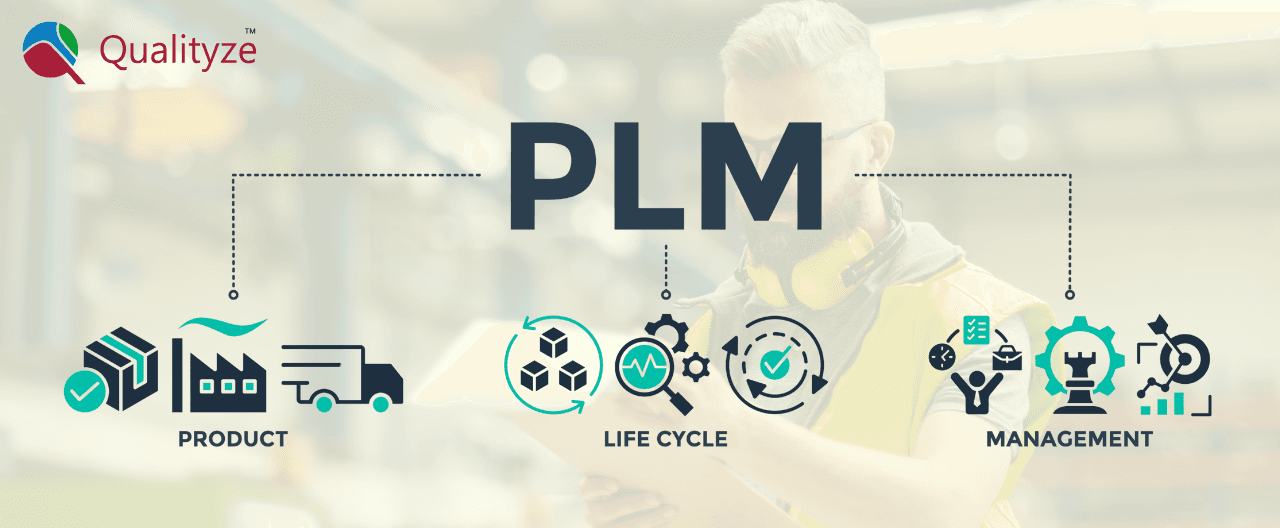
Product Lifecycle Management or PLM software is a comprehensive digital framework that assists in managing all the information, engineering data, and processes related to a product from its conception to the end of its life. PLM gives a thorough insight into the product's phases as opposed to isolated tools concentrating merely on 3D design or financial accounting. It brings together the people's data processes, and business systems to create a shared information backbone for the main company and its extended supplier networks.
Typically, the lifecycle stages controlled within this digital platform are as follows:
It is important to know the difference between PLM and other enterprise systems. Product Data Management (PDM) is mainly concerned with engineering files and CAD data. However, PLM spans the entire business process. Enterprise Resource Planning (ERP) systems deal with running production, finance, and logistics operations after the design has been completed. Application Lifecycle Management (ALM) resembles PLM but pays more attention to software development. In the current industrial operations, it is common for these separate systems to be interconnected to have no data silos.
In 2026, the manufacturing landscape will be defined by highly complex products and extremely vulnerable global supply chains. Products will have evolved beyond mere mechanical things: they will be smart, connected systems integrating hardware, software, and electronic components. Handling the interrelations among such a diverse range of components would be utterly unmanageable without a central product data environment.
Global supply chains have become a lot more unstable, which means manufacturers have to work closely with partners in different time zones and regulatory regimes. PLM supports this kind of widespread collaboration. It guarantees that a supplier in one country works on the very same design version as the engineering team in another. This way, you avoid the expensive manufacturing error situations resulting from using outdated specifications.
The pace of innovation has been significantly ramped up. Not only do end users but also enterprise customers demand more features and quicker releases, which means that companies have no choice but to shorten their cycle times big time. The only way to hit market launch times as tight as today's without compromising on safety and quality is by a central PLM system that enables parallel engineering where one team can simultaneously work on the design, another on manufacturing planning, and a third on service documentation.
The scale of financial resources invested in this technology demonstrates its importance. According to Coherent Market Insights, the global Product Lifecycle Management market is forecasted to grow to 38,608.1 million US dollars by 2026. This figure clearly shows that digital transformation of the product creation process is crucial for organizations striving to outperform their rivals.
The main benefit of using PLM is the introduction of a "single source of truth." If all departments access the same data repository, the risk of data duplication and inconsistency will be eliminated. This centralization means that if a change is made to an engineering design, manufacturing and service teams will know it immediately, thus not being able to produce obsolete or dangerous parts.
Big leaps are made in product quality and compliance when lifecycle management is done properly. If quality checks and regulatory requirements are built into the product development workflow, companies can guarantee that the lifecycle stages are compliant with safety standards. It is also very important for companies that must follow strict environmental and safety regulations.
The economic advantages are mainly cutting the development costs and shortening the time to market. By making the design process more efficient and identifying the possible manufacturing issues early on through virtual simulation, companies will be saved of the huge costs that come with engineering changes at a late stage and physical prototyping. Besides that, cross-functional collaboration is forever improved because the system is a common language and platform for engineers, designers, purchasers, and marketers to interact without difficulty.
Only a strong PLM system with specific features can handle the complexities of the products of today effectively. Managing Bill of Materials (BOM) is by far the most significant feature. The system should be able to handle different versions of the BOM, such as the Engineering BOM (EBOM) for design and the Manufacturing BOM (MBOM) for the actual manufacturing process. This makes sure that there is a clear, continuous connection between the design of the product and the way it is made.
Version control and change management are just as important. Software must be able to save every version of a design and be able to handle the Engineering Change Order (ECO) process using automated workflows. This is a way to make sure that only approved changes are made and that there is a full audit trail of who made a change, the time the change was made, and the reason for it.
Workflow automation lessens the paperwork for engineers as it automatically sends documents for approval. Integration with CAD, ERP, and Manufacturing Execution Systems (MES) is a must in an up-to-date digital environment. Finally, management is able to use advanced analytics and reporting features to keep track of project status, spot production slowdowns, and decide on future product portfolios based on data.
When evaluating PLM software, organizations must look at scalability, cloud maturity, AI integration, and the ability to handle multi-disciplinary product data.
| Software | Deployment | Best Fit Industries | Key Strength |
| Siemens Teamcenter | Hybrid/Cloud | Aerospace, Auto, Heavy Machinery | Deep multi domain integration |
| PTC Windchill | Cloud/On-Premises | Discrete Mfg, MedTech | Strong CAD & IoT connectivity |
| SAP PLM | Cloud Native | Global Enterprises | Supply chain & Finance alignment |
| Aras Innovator | Hybrid | Specialty Mfg, Defense | Extreme flexibility & Customization |
| Qualityze | Cloud (Salesforce) | Life Sciences, Regulated Mfg | AI-Powered Compliance & Quality |
| Propel PLM | Cloud Native | Consumer Goods, High Tech | Customer centric lifecycle |
| PTC Arena | Cloud Native | Electronics, MedTech | Supply chain collaboration |
| Oracle Cloud PLM | Cloud Native | Consumer Electronics, Pharma | Integrated enterprise analytics |
| Dassault ENOVIA | Hybrid | Aerospace, Life Sciences | Advanced 3D & Simulation |
| Autodesk Fusion | Cloud Native | SMB, Startups | Unified Design & PLM |
Above all, industry-specific needs are the top priority. For example, a life sciences company might need an environment that has very strong document control features to comply with regulations. On the other hand, an electronics manufacturer would require software that allows deep multi-tier supplier collaboration and component management. Apart from industry-specific features, integration and scalability issues should also be considered when deciding on the solution. The software must be scalable and capable of interacting with existing ERP and MES systems without the need for heavy custom IT development.
Choosing the right platform will most definitely entail a thorough analysis of the company size and really the industry specifics at a very precise level. As a general rule, small and mid-sized businesses (SMBs) should focus on cloud native solutions which will provide them with lower upfront investment and faster time to market. However, very large corporations having complex legacy systems and diverse multi-domains requirements very often consider that the very strong features of an enterprise platform are instrumental for them to be able to effectively operate at a worldwide scale.
In regulated sectors such as medical devices, pharmaceuticals, and aerospace, product lifecycle management being the main instrument of public safety and compliance with the law. Here, it at the same time handles the extensive documentation requirements posed by the FDA, ISO, and GMP standards. For these companies, the product lifecycle indicates the product's compliance history.
Traceability and audit readiness stand out as fundamental success factors in these types of organizations. The system reveals the full history of the product, the so-called "cradle to grave" record. In the event of a quality issue in the field, the system enables investigators to pinpoint a specific batch of raw materials or a particular design revision in a matter of seconds.
The supervision of compliance has become increasingly stringent over time. From the Food and Drug Administration data regarding inspectional observations, documentation and design control deficiencies still rank among the most common citations for manufacturers worldwide. An efficient system makes sure that these controls are not only automated but also uniformly executed, thereby lessening the chances of being subjected to regulatory actions and warning letters.
Even though these three systems frequently exchange information, each one has a different main goal and is focused on a particular aspect.
The reason why integrated ecosystems are so critical is very straightforward: scattered data leads to disastrous mistakes. Upon integration of each of these systems, one is able to experience "closed loop quality". Let's say a customer complaint is registered in the quality system; this information is then used to automatically initiate an Engineering Change Request in the design environment, which later modifies the BOM in the operations system. Such a smooth exchange of data is a feature of the best manufacturing companies.
The biggest barrier to successful digital transformation has always been the difficulties related to data migration. For instance, transitioning legacy CAD files, spreadsheets, and paper records spanning decades into a structured system is a very complicated and long process. If the organization simply relocates its existing problems into a newer, more expensive system without data cleaning and organizing, then they have failed to solve the issue and have only compounded it.
The other human challenge that plays a role is the resistance to change. Engineers and designers have working methods that suit them personally, and they see new system procedures as an added burden, especially the bureaucratic element. It is only by a strong leadership team and through careful communication of long-term benefits that one can overcome this barrier. Another technical challenge is the integration complexity, as the linking of new software with existing legacy systems can be quite tricky.
The first step to a successful rollout is clear product data strategy. An organization should define its management method of parts, BOMs, and engineering changes even before engaging a vendor. The strategy should ideally be vendor-friendly with primary focus on business goals. It is absolutely necessary to get different teams on the same page.
Implementation should not be considered an isolated IT project; top management must involve business users in engineering, manufacturing, and quality assurance for the initiative to succeed. Making sure training is done well and that people start using things with ease are two steps that are last but very important. It is not enough for the users to just know how to press the buttons; it is essential that they also understand the reasons for the change in processes. Phasing, i.e. starting with one product line or department, has been proven by research to have been much more beneficial than a huge, companywide launch.
The way these systems function is being altered greatly by artificial intelligence. AI-based product insights and predictive analytics can recommend designing improvements using historical performance data and worldwide market trends. Such smart systems might uncover supply chain risks or manufacturing failures even before they happen, thus engineers would be able to make proactive changes.
Digital twins are one of the technologies that have a strong impact on product development. It is a virtual representation of a physical product, and it is updated with real-time field data through the integration of IoT. As a result, manufacturers are capable of monitoring the status of their products live, adjusting maintenance schedules for optimum performance, and incorporating the data into the design process for new versions.
As cloud native and SaaS models are the main focus now, the change is being driven strongly by them, thus offering companies flexibility beyond their imagination and at the same time reducing the cost of their IT departments.
By 2028, Gartner predicts that over half of the generative AI models used by enterprises will be domain specific, providing higher accuracy and better compliance for industry specific tasks. For manufacturing, this means AI agents that understand the exact engineering and regulatory context of a product, further accelerating the innovation cycle and reducing human error.
PLM software is more than just a tool in today's world of industry; it is an absolute necessity to remain competitive. It offers engineering visibility, coordination, and traceability which are all required to stay ahead in the face of ever-growing technical complexity and regulatory controls. By bringing product data together and linking the entire product lifecycle, businesses can innovate more quickly, cut down on production costs and adhere to very high levels of safety without any compromise.
Digitization, cloud computing, and AI-enabled tools are the key drivers for the market players today to continue in business. Firms that not only adopt these new platforms but also make them an integral part of a diversified ecosystem of business applications will have the advantage of being the leaders of their industries. The future of product development is virtually exclusively with those who can handle their digital data as proficiently as they handle their physical goods. To set aside money for a well-structured management system can be regarded as the best step in making sure that your company will remain competitive and resilient for a long time.
Author

Qualityze Editorial is the unified voice of Qualityze, sharing expert insights on quality excellence, regulatory compliance, and enterprise digitalization. Backed by deep industry expertise, our content empowers life sciences and regulated organizations to navigate complex regulations, optimize quality systems, and achieve operational excellence.