Next-Gen Quality Management. Built for Compliance. Powered by AI.
Imagine a hospital with no wait, clear communication, and a safe, calming environment. Specifically, this isn't just luck it's the result of effective quality management in healthcare.
Furthermore, healthcare quality management uses structured approaches to continuously improve patient care, safety, and service delivery. In essence, it's about ensuring that every patient receives the right care at the right time, consistently.
Moreover, given the sensitive and complex nature of healthcare, even minor mistakes can have significant impacts. Therefore, hospitals and healthcare facilities place immense importance on robust quality management system. Ultimately, this blog explores the meaning, key components, and vital importance of quality management in modern healthcare operations.
Firstly, healthcare quality management has evolved from basic record-keeping to sophisticated systems using evidence-based analytics and continuous improvement. Consequently, quality management encompasses three core pillars:
Together, these elements form a comprehensive approach to healthcare quality management, ensuring facilities consistently deliver safe, reliable, and high-quality care to patients.
Inclusively, a strong quality-management framework in healthcare weaves together several interlocking components each one tackling a different dimension of care, safety, and compliance. Consequently, when these pieces work in harmony, they create a feedback-driven engine for continuous improvement.
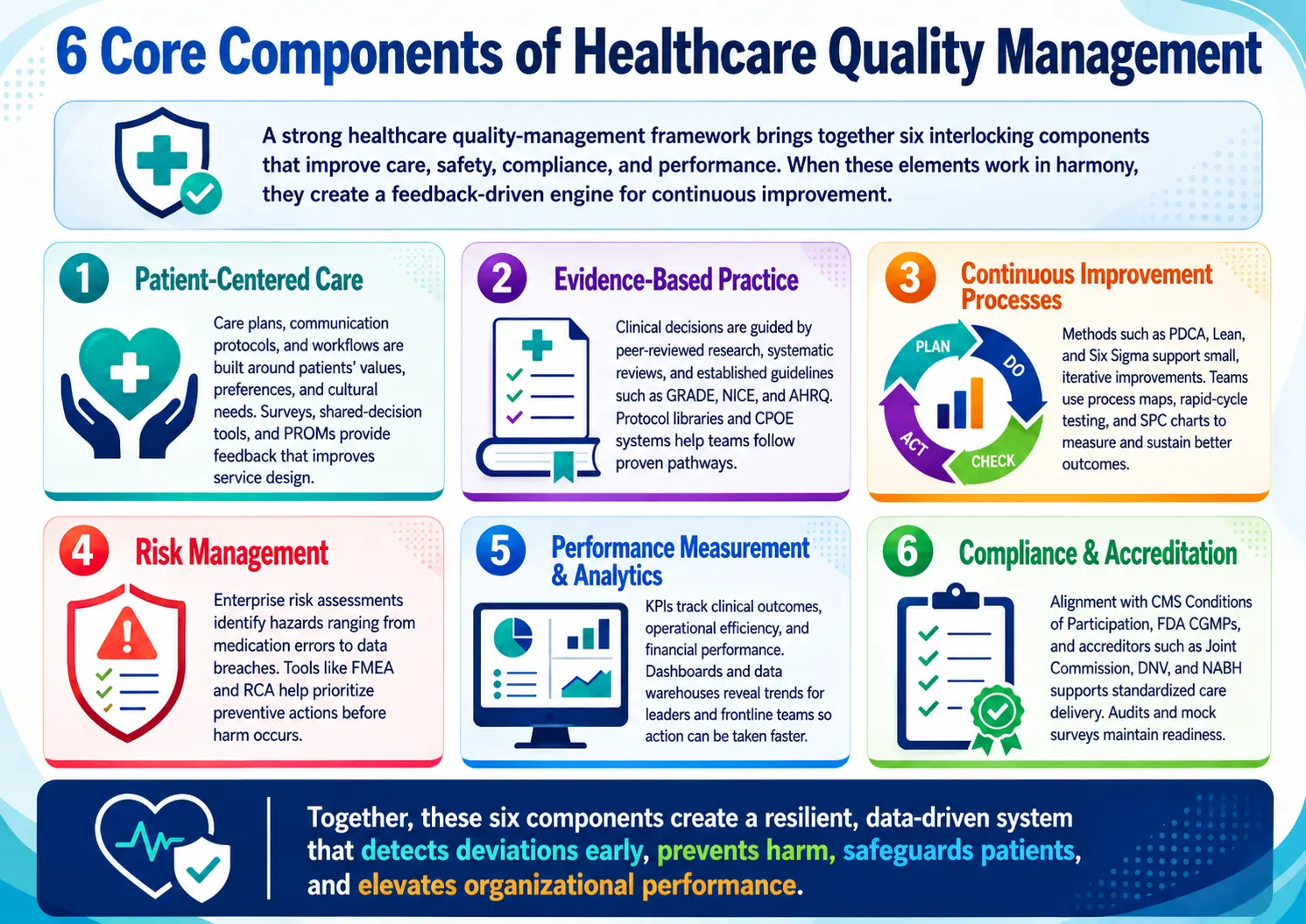
In short, these components collectively create a resilient, data-driven system that not only detects deviations early but also empowers teams to prevent them ultimately safeguarding patients and elevating organizational performance.
Healthcare is a high-stakes environment every process failure can translate directly into patient harm, regulatory penalties, or spiraling costs. Robust quality management programs safeguard patients and organizations in six critical ways:
Key Benefit |
How Quality Management Delivers Value |
| Patient Safety | Firstly, standardized protocols, double-checks, and incident-reporting systems reduce medication errors, wrong-site surgeries, hospital-acquired infections, and other sentinel events. |
| Clinical Outcomes | Thereafter, evidence-based pathways and continuous-improvement cycles drive lower mortality, fewer readmissions, faster recoveries, and improved quality-of-life scores. |
| Regulatory Compliance | Systematic documentation, audit trails, and validated workflows help organizations satisfy CMS Conditions of Participation, FDA CGMPs, HIPAA, and accreditation bodies such as The Joint Commission or NABH avoiding citations and fines. |
| Operational Efficiency & Cost Control | Furthermore, Lean Six Sigma projects eliminate waste (e.g., excess inventory, redundant tests), shorten length of stay, and optimize resource utilization, directly lowering cost per case. |
| Reputation & Patient Trust | Publicly reported quality metrics, HCAHPS scores, and accreditation seals increasingly influence patient choice and payer negotiations; sustained high performance attracts both patients and top clinical talent. |
| Risk Mitigation & Liability Reduction | Lastly, proactive risk analyses (FMEA, RCA) and closed-loop corrective actions shrink malpractice exposure and insurance premiums, safeguarding financial stability. |
In essence, quality management isn’t an optional “nice-to-have” program it’s the backbone of safe, effective, and financially viable care delivery in modern healthcare systems.
Quality management serves as the operational backbone that translates clinical standards and policy into day-to-day practice. Its responsibilities span strategic planning, execution, and continuous oversight.
The Institute of Medicine (IOM) defines six core aims often called “quality domains” that every healthcare organization must master to deliver high-value, patient-focused care. Each domain targets a specific dimension of performance; taken together, they form a comprehensive blueprint for quality initiatives.
Preventing harm is the foundational obligation of any healthcare system. Safety programs focus on reducing medication errors, healthcare-associated infections, wrong-site procedures, and device failures. Tactics include standardized checklists, electronic medication administration records (eMAR), bar-code verification, and robust incident-reporting with root-cause analysis.
Care must align with the best available scientific evidence and clinical guidelines. Data analytics, clinical decision support, and adherence monitoring ensure that interventions deliver proven benefits and avoid unnecessary tests or treatments that offer no added value.
Quality care respects each patient’s values, preferences, and cultural needs. Tools such as shared-decision-making aids, personalized care plans, and real-time experience surveys translate patient voice into actionable improvements, boosting satisfaction and trust.
Delays in diagnosis, treatment, or discharge can lead to complications and higher costs. Lean value-stream mapping, e-referral pathways, and capacity-management dashboards help organizations shorten wait times, expedite test results, and smooth care transitions.
Resource stewardship reduces waste duplicate diagnostics, excess inventory, prolonged length of stay while preserving or enhancing outcomes. Techniques like Six Sigma, just-in-time inventory, and predictive staffing models optimize throughput and cost per case.
High-quality care must be consistently available to all patients, regardless of race, gender, socioeconomic status, or geographic location. Stratifying performance metrics by demographic factors, closing language-access gaps, and partnering with community organizations are key strategies for eliminating disparities.
By structuring improvement efforts around these six domains, healthcare providers create a balanced scorecard that captures both clinical excellence and the patient experience, ensuring quality gains are broad-based, sustainable, and socially responsible.
Below are five concrete cases that show how structured quality-management methods translate into safer care, better outcomes, and measurable cost savings.
Using evidence-based tools within a disciplined quality framework improves both patient safety and operational performance.
To begin with, below is a “starter toolbox” for hospitals and clinics that want to build or modernize a rigorous quality program. Each entry pairs a proven methodology with the software or data infrastructure that turns theory into day-to-day practice.
Firstly, Cloud-based eQMS platforms (e.g., Qualityze) centralize document control, CAPA, audit, risk, and training records on a single, validated database. Consequently, role-based access, electronic signatures (21 CFR Part 11), and real-time dashboards eliminate paper waste and keep organizations inspection-ready.
Secondly, Fishbone (Ishikawa) diagrams, 5 Whys worksheets, and RCA workflow apps guide multidisciplinary teams through systematic investigation of adverse events or near misses. Furthermore, coupling these tools with an eQMS CAPA module ensures corrective actions are assigned, verified, and trended over time.
Then, HFMEA endorsed by AHRQ and The Joint Commission maps possible process failures, scores them for severity × occurrence × detectability, and prioritizes fixes before harm occurs. Moreover, interactive FMEA modules embedded in many eQMS suites auto-calculate risk-priority numbers and track mitigation status.
Thereafter, PDCA templates in QI software help frontline teams test small changes, analyze results via run charts, and standardize successes while maintaining auditable records.
Additionally, hospitals use DMAIC (Define-Measure-Analyze-Improve-Control) to cut waste and variation from OR turnover time to pharmacy dispensing errors. Hence, digital value-stream-mapping boards, SIPOC builders, and statistical toolkits speed project execution and coaching. Case studies show sustained reductions in defects and cost per case.
Furthermore, SPC engines integrate live data to plot control charts (XmR, p, u), helping teams address special-cause variation before metrics like infection rates drift.
Thereafter, enterprise analytics platforms aggregate KPIs across safety (CLABSI, CAUTI), outcomes (mortality, PROMs), and financials. Moreover, registry integration enables peer benchmarking and drill-down views to target resources toward the largest performance gaps.
Lastly, machine-learning models embedded in CDSS or standalone tools scan EHR streams to predict sepsis, acute kidney injury, or patient-deterioration hours earlier than vitals alone. Additonally, FDA-cleared examples such as Prenosis’s Sepsis Immunoscore and UK NHS’s new AI safety-signal network illustrate the shift from retrospective review to real-time prevention.
To clarify, no single tool covers every domain; high-reliability organizations layer them. Furthermore, start with an EQMS backbone like Qualityze, add RCA/FMEA for event analysis and proactive risk, embed Lean Six Sigma for process redesign, and overlay SPC dashboards plus AI alerts for continuous, data-driven surveillance. Above all, evaluate the chosen solution for interoperability (FHIR/HL7), validation status, cybersecurity posture, and Total Cost of Ownership before rollout.
First of all, these efforts reduce adverse events and costs while improving trust, throughput, and regulatory readiness. Moreover, quality management is a journey, not a destination. AI, predictive dashboards, and FHIR interoperability are continuously redefining the benchmarks for excellence in healthcare quality.
Author

Qualityze Editorial is the unified voice of Qualityze, sharing expert insights on quality excellence, regulatory compliance, and enterprise digitalization. Backed by deep industry expertise, our content empowers life sciences and regulated organizations to navigate complex regulations, optimize quality systems, and achieve operational excellence.