
Next-Gen Quality Management. Built for Compliance. Powered by AI.
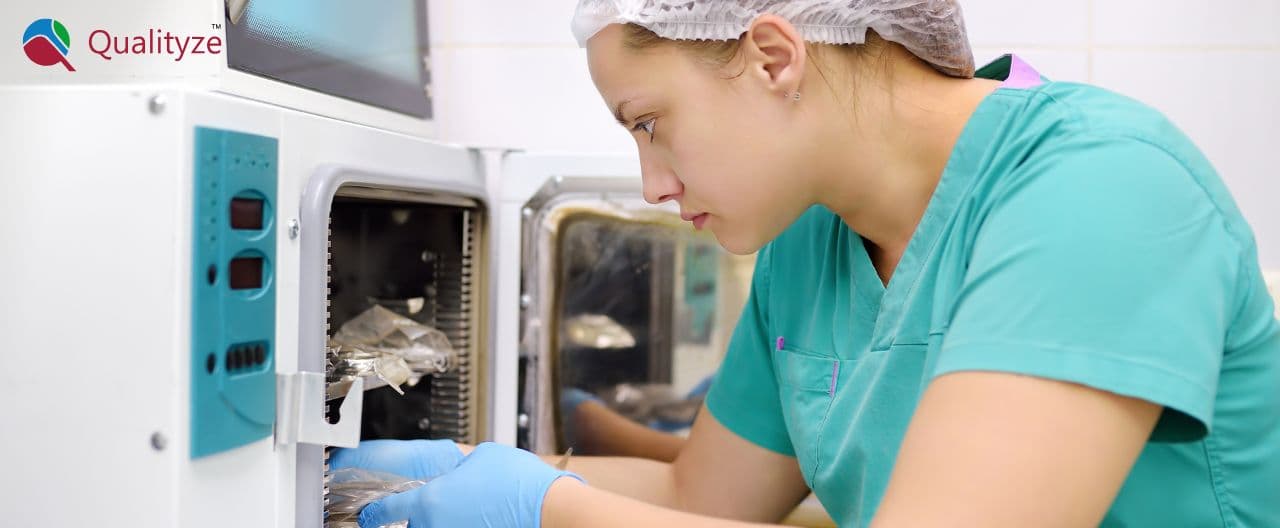
When you walk into a hospital, you usually notice the nurses, doctors, or the smell of antiseptics. What you probably do not see are the teams working in the basement or the back hallways to make sure every tool used in a surgery is perfectly safe. Their work is the reason a routine procedure does not turn into a serious problem. This work is called sterilization. It is not just about making things look clean. It is about making sure there is no microscopic life left on an instrument that could cause an infection. It might look like a simple job, but it is one of the most important aspects of the modern healthcare system.
Let’s look at it in more detail.
In a simple layman term, sterilization is the process of killing every single germ on an object. This includes the tough ones, like spores, that can survive almost anything. Obviously, in a hospital, there is no middle ground. An instrument is either sterile, or it is not. Just assume, if a surgical blade has even one living microorganism on it, technically the whole process has failed.
Now, it becomes essential to know how this is different from cleaning or disinfection. People often use these words as if they mean the same thing, but in a clinic or a hospital, they are stages of a larger job, Let’s see how.
Now that we have discussed the What, it becomes crucial to understand the Why.
The main reason we focus so much on this is to prevent healthcare-associated infections (HAI). These are infections that patients get while they are being treated for something else. They happen when a germ finds a way into a patient's body through a tool that is not handled correctly. When this happens, a simple stay in the hospital can become much longer and much more dangerous. And to be very frank, nobody likes that.
Patient safety is the goal here. If the tools are safe, the outcomes are better. There are also big legal and regulatory reasons to get this right. Hospitals have to prove they are following the rules to keep their licenses. If they cannot show that they are sterilizing things properly, they can face huge fines or even be shut down.
There has been some good news on this front lately. According to a 2024 National and State HAI Progress Report released by the CDC in January 2026, there was a clear drop in several types of infections. Hospital-onset C. diff infections went down by 11 percent, and certain urinary tract infections fell by 10 percent.
This shows that the effort hospitals are putting into these practices is working, but it also reminds us that we have to keep going to get those numbers even lower. It’s no rocket science to understand that an excellent healthcare system eventually improves our lives.
Next, it is also important to understand the several procedures used in Sterilization. Let's see that now.
Not every tool can be treated the same way. Some can handle high heat, while others would melt or break. This is why we have different ways to get the job done.
Any method cannot be efficient until and unless there are underlying principles that drive it. In sterilization, too, there are few.
To make sure sterilization actually works, you have to follow a few basic rules. The first is that you must clean everything before you try to sterilize it. If there is a tiny bit of dried blood on a hinge, the steam might not reach the metal underneath. That little bit of dirt acts like an umbrella for the germs.
The way you pack and load the machine matters, too. You have to use special wraps that let the steam in but keep the germs out once the machine is opened. You also cannot cram too many things into the machine. If it is too crowded, the steam cannot move around, and you might end up with spots that did not get hot enough.
You also have to pick the right cycle for the tool you are working on. Every manufacturer provides instructions on how to handle their equipment. Finally, you have to monitor the process. You do not just assume it worked because you turned the machine on. You use tests to prove it or validate it.
The best hospitals do not just follow the rules; they build habits that make mistakes almost impossible.
There are groups that spend all their time deciding what the safest practices are. In the United States, we look to the FDA and the CDC for guidance. There are also international rules, like ISO standards, that give very specific technical details on how to run a sterilization program.
Following these rules is not just about safety; it is about staying in business. The FDA has become much more active in checking these things recently.
In 2025, the number of warning letters issued by the FDA went up by 50 percent. Many of these were for companies that did not have good records or failed to follow their own quality rules. For medical device makers, these mistakes can cost a lot of money, with some estimates saying the industry loses up to 9 billion dollars a year because of compliance issues.
We use three different ways to make sure a sterilization cycle was a success. We don't just rely on one because we want to be absolutely sure.
Regular audits are also a big part of quality assurance. This means someone coming in to watch the process and check the records to make sure no one is cutting corners.
Even with great machines, things can go wrong. Usually, it is because of a human error. The biggest one is not cleaning the tools well enough before they go into the sterilizer. If the tool is dirty, the sterilization will fail. Another common issue is overloading the machine. People are often in a hurry to get tools back to the doctors, so they try to fit too much in at once.
Using the wrong settings for the cycle is another problem. This often happens when a hospital gets new equipment and the staff has not been fully trained on it yet. Poor documentation is also a huge risk. If you do not have a record of a test, it is the same as not doing the test at all.
Hospitals are spending more money to fix these problems by buying better equipment.
The market for sterilization gear was worth 7.72 billion dollars in 2025 and is expected to grow to over 8 billion dollars in 2026.
This shows that more facilities are moving away from old, manual ways of doing things and investing in machines that are harder to mess up.
We categorize tools based on how much risk they pose to the patient. This is called the Spaulding classification.
Handling endoscopes is especially hard. They have tiny tubes inside that are very difficult to clean. They need special machines and extra care to make sure they are safe for the next patient.
As technology advances by the day, sterilization has become much more reliable. We are moving away from a pile of papers and manual checks toward systems that do the thinking for us.
The most challenging part of this process is that nowadays medical instruments are becoming increasingly complicated. They come with moving parts, small openings, and delicate electronic components that make the entire sterilizing process much more difficult compared to when we used plain metal instruments long ago.
The compliances are also getting stricter. This means more paperwork and more pressure on the staff. On top of that, hospitals are always trying to save money or take cost-cutting measures. Finding the balance between being as safe as possible and keeping costs down is a constant struggle for managers.
The future of this field lies in becoming more intelligent and sustainable. There is an observable trend towards low-energy technologies that utilize less energy. In addition, there has been a noticeable development of AI that monitors the data generated by sterilization procedures in order to prevent errors.
Sustainability is becoming a big deal, too. Hospitals use a lot of water and electricity for sterilization. New machines are being designed to recycle water and use less power. Governments are starting to put more money into this as well.
The WHO has a goal for at least half of the countries in the world to have a specific budget for infection prevention and control by 2026.
This extra funding will help hospitals buy the new technology they need to keep patients safe.
Sterilization might not be the most glamorous part of healthcare, but it is one of the most important. It is the work that happens in the background to make sure the work in the operating room is successful. By following simple best practices, training staff well, and using modern technology, hospitals can make sure they are doing everything possible to protect their patients. As the tools we use get more complex, the systems we use to clean them have to get better too. It is a constant job of getting better every day, but it is the only way to ensure that every patient is safe.
Author

Qualityze Editorial is the unified voice of Qualityze, sharing expert insights on quality excellence, regulatory compliance, and enterprise digitalization. Backed by deep industry expertise, our content empowers life sciences and regulated organizations to navigate complex regulations, optimize quality systems, and achieve operational excellence.