Next-Gen Quality Management. Built for Compliance. Powered by AI.
In the high-stakes world of modern manufacturing and regulated life sciences, disorder is a silent profit killer. Many organizations mistakenly view 5S as a superficial cleaning day, failing to realize that a cluttered workspace is a direct indicator of deeper process inefficiencies, safety hazards, and impending compliance failures. When tools are missing, inventory is unorganized, and workstations are neglected, the resulting motion waste and defects erode the bottom line.
The 5S methodology in lean manufacturing provides a rigorous, five-step framework designed to transform physical chaos into a self-explaining, visual workplace. This system does more than tidy a floor; it creates an environment where any deviation from the standard is immediately visible, allowing for rapid intervention. For companies pursuing digital transformation, 5S is the non-negotiable prerequisite. You cannot effectively digitize a mess; you must first stabilize the environment to ensure data integrity.
In this blog, we will dissect the core lean 5S principles, analyze the quantifiable workplace organization benefits, and provide a comprehensive roadmap for moving from manual checklists to high-impact digital QMS integration.
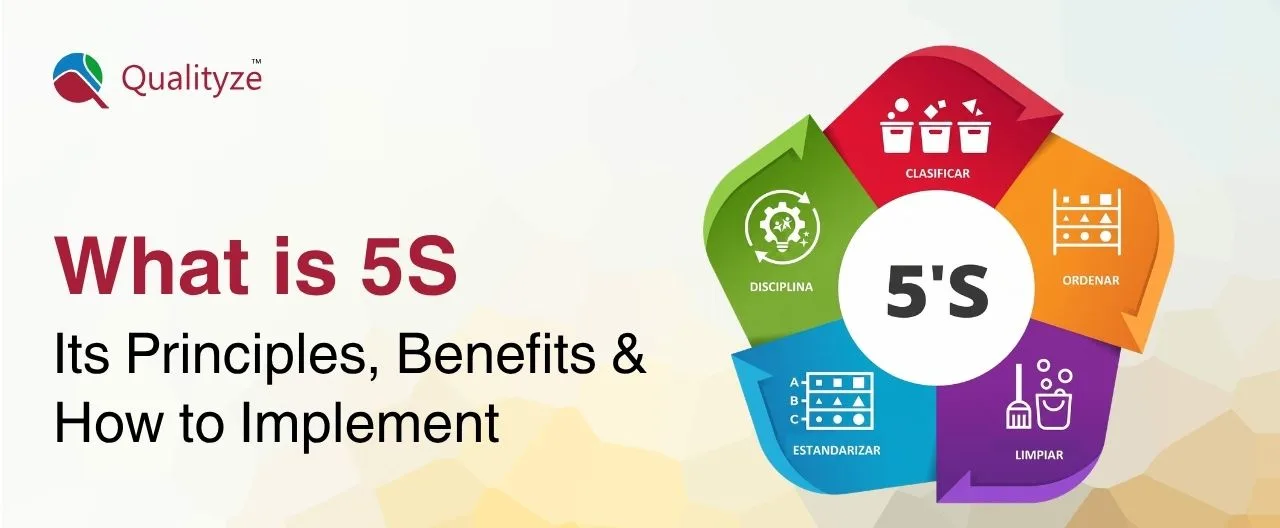
At its core, 5S is a workplace organization methodology that uses five Japanese terms; Seiri, Seiton, Seiso, Seiketsu, and Shitsuke to create a workspace that supports high-efficiency production. It is a functional component of Visual Management, and the goal is to ensure that every tool, part, and piece of information has a designated home and that the status of the workplace is apparent to anyone at a glance.
The roots of 5S trace back to the Japanese industrial post-war recovery, specifically the Toyota Production System (TPS). Pioneers recognized that to achieve Just-in-Time production, the environment had to be perfectly predictable. While the concept originated in automotive plants, it has since become the global standard for any industry where quality and safety are paramount.
Modern quality management is increasingly data-driven. However, data integrity begins at the source the shop floor. If a technician cannot find a calibrated gauge because of a disorganized workbench, the resulting measurement error compromises the entire QMS data set. 5S provides the physical discipline required to support the digital accuracy that modern platforms provide.
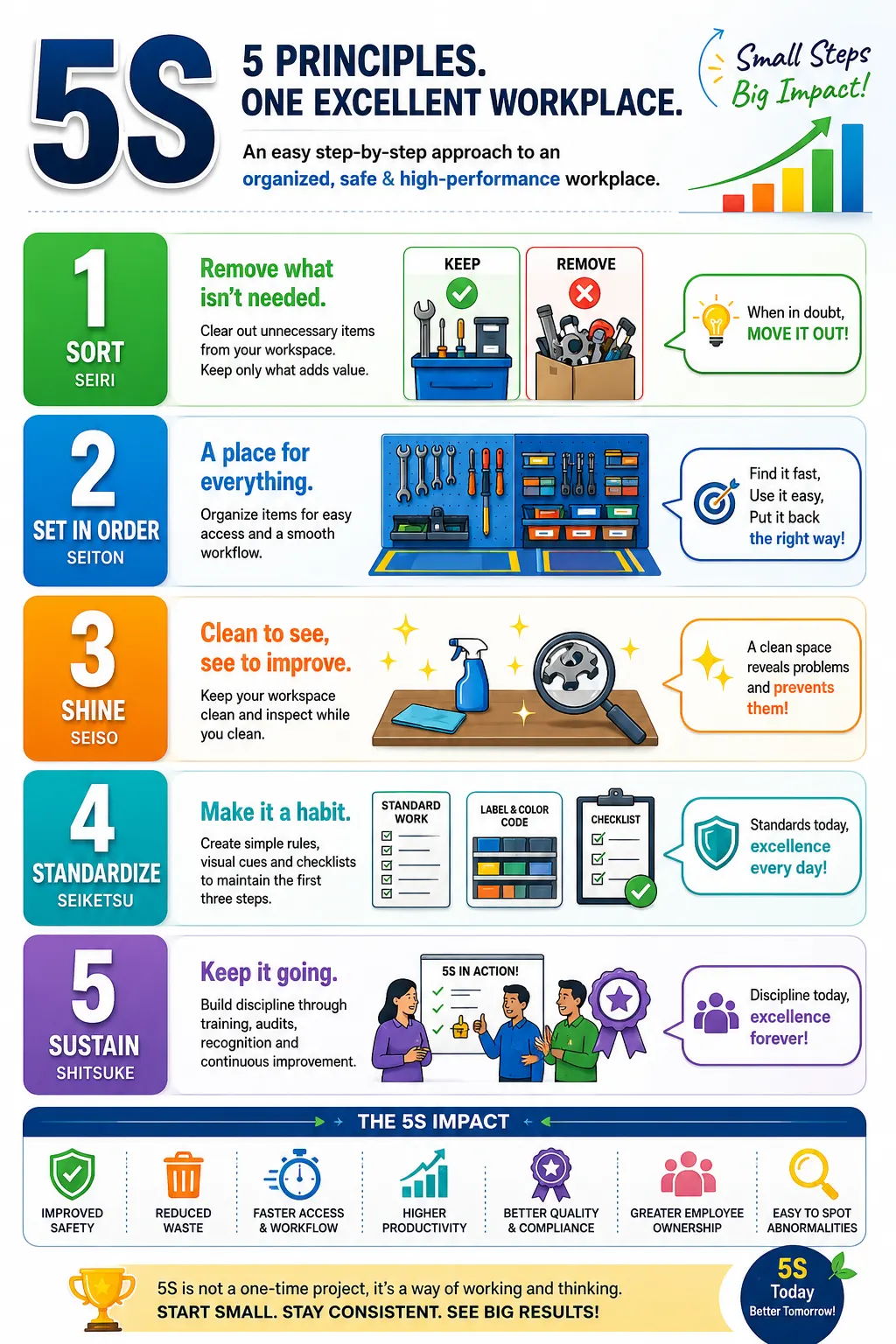
For 5S to be effective, the phases must be executed in a strict, logical sequence. Skipping a step or performing them out of order is the primary reason most organizational initiatives fail within the first six months.
Sort (Seiri) – Removing Unnecessary Items: This phase requires a ruthless audit of the work area. Any item that is not essential for the current production process must be removed. This is often handled through Red Tagging, where questionable items are moved to a central holding area for final disposition.
Set in Order (Seiton) – Organizing for Efficiency: Once the clutter is gone, the remaining essential items are arranged based on the frequency of use. This involves using visual management tools like shadow boards, floor markings, and labels. The objective is to minimize motion waste.
Shine (Seiso) – Cleaning and Inspection: Shine is often misunderstood as simple janitorial work. In a lean environment, cleaning is a form of inspection. As operators clean their machines, they are trained to look for leaks, cracks, or loose bolts.
Standardize (Seiketsu) – Creating Consistent Processes: Standardization is the bridge between a one-time cleanup and a permanent system. This involves creating the schedules, visual aids, and Standard Operating Procedures (SOPs) that define what good looks like.
Sustain (Shitsuke) – Maintaining Discipline and Culture: Sustain is the most challenging pillar. It involves the behavioral shift where 5S becomes a fundamental part of the company culture. This is achieved through continuous training and the use of a formal 5S audit checklist.
The impact of lean 5S principles extends far beyond aesthetics. When the physical environment is controlled, the operational risks are significantly mitigated.
Improved Workplace Efficiency: By eliminating the time wasted searching for tools, facilities often see a 10% to 30% increase in overall labor productivity.
Reduced Waste and Operational Costs: 5S directly targets the Seven Wastes of Lean, reducing inventory damage and overhead costs associated with excess floor space.
Enhanced Safety and Compliance: Clearly marked walkways and spill-free floors reduce slips, trips, and falls the leading cause of workplace injuries.
Better Quality Control: In an organized environment, a part that is out of place or a machine that is leaking stands out immediately, preventing defective products from moving further down the line.
While the 5S methodology originated on the automotive assembly line, its core logic stabilizing an environment to ensure predictable outcomes is universal. Today, 5S has transcended the shop floor to become a critical operational framework in sectors where precision, safety, and regulatory compliance are non-negotiable.
Whether in a high-tech laboratory or a fulfillment center, the application of 5S principles allows organizations to tailor their visual management strategies to meet specific sectoral challenges.
Moving from a conceptual understanding to shop-floor execution requires a tactical roadmap that prioritizes cultural buy-in over simple physical movement. A successful rollout is never a top-down mandate; it is a structured, phase-based project that empowers the people who actually do the work to define their own environment.
Empowering employees with the right visual management tools is what makes the difference between a temporary cleanup and a permanent cultural change. These instruments are designed to make the status of the workplace obvious at a glance, removing the cognitive load of searching for information or equipment.
Most 5S failures are not due to a lack of technical knowledge, but a failure to address the human and organizational friction that arises during any major transition. Understanding these roadblocks allows leadership to anticipate resistance and proactively build the bridges necessary for long-term adoption.
The ultimate test of a 5S program is not the state of the facility on day one, but its condition six months later. Sustainability is achieved only when the new standards become the path of least resistance, supported by consistent leadership presence and a deep sense of operator ownership.
A methodology that is not measured cannot be managed. To transition from a subjective feeling of order to an objective standard of excellence, organizations must rely on data-driven audits and key performance indicators that link physical organization to financial outcomes.
Success is measured by the correlation between 5S audit scores and operational performance.
From the records! According to 2025 benchmark data from Quality Progress, organizations that digitize their 5S audit checklist see a 42% faster cycle time in closing out non-conformances.
While these methodologies are often grouped together, they serve distinct roles within the quality ecosystem. Understanding the synergy between these frameworks allows leadership to deploy the right tool at the right time, ensuring that speed is never gained at the expense of stability or statistical accuracy.
Modern manufacturing is too complex for paper systems. A digital Quality Management System acts as the engine for your 5S program.
The 5S methodology is ultimately a journey of cultural transformation, moving an organization away from reactive firefighting toward a state of disciplined, visual excellence. While the individual steps Sort, Set in Order, Shine, Standardize, and Sustain may appear straightforward, their cumulative impact on operational stability and product quality is irreplaceable. By meticulously organizing the physical environment, leadership creates the necessary clarity for the workforce to focus on high-value innovation rather than navigating avoidable clutter.
Sustaining these gains, however, requires more than manual effort; it requires a bridge between physical discipline and digital oversight. As manufacturing environments become more complex, the ability to automate audits and link floor-level order to enterprise-level quality becomes the true differentiator. Establishing this standardized foundation ensures that as your organization scales, your commitment to safety, efficiency, and compliance remains unshakeable. Qualityze Quality Management Software provides the digital architecture to turn these manual 5S habits into a permanent, data-driven standard of excellence.
Author

Qualityze Editorial is the unified voice of Qualityze, sharing expert insights on quality excellence, regulatory compliance, and enterprise digitalization. Backed by deep industry expertise, our content empowers life sciences and regulated organizations to navigate complex regulations, optimize quality systems, and achieve operational excellence.